
Value for all
Annual Report SeeYou 2025
2025 02. Foreword

Foreword
Jolanda Omvlee
‘There is strength in working together: what we share bears more fruit.’
(free translation of Ecclesiastes 4:9)
2025: my first year as Executive Director of SeeYou. A year of listening, learning and determining the way ahead together. During this valuable and rich year, I was continuously inspired by the stories of people who regained their sight and, with that, their chances of a better future.
How can we do justice to people without a voice and, in doing so, contribute to a world in which everybody can participate? In my view, doing justice goes hand in hand with equality. And equality begins with all of us, including me. Do I see ‘somebody with disabilities’ and ‘somebody living in poverty’? Or do I look further and realise that we are not so different after all? Because sooner or later, we all experience challenges and obstacles in life. Our ambassadors Jurjen, Roos and Berdine are good examples of that. Due to their disabilities, they have experienced a wide range of challenges and the resilience and hope they possess are a huge source of inspiration to others. As our new ambassador, Roos Botman says in this annual report: ‘Healthy people are severely limited.’
This sense of equality is the perspective and inspiration for all our collaboration at SeeYou. Our impact grew precisely because we had the confidence to let go. For example, we saw that in the five-year We are Able! Programme, which we completed this year together with all partners. Local partner organisations are increasingly taking the lead, and we are right by their side when it is necessary to facilitate. Together, we achieve sustainable change by recognising each other’s expertise, encouraging initiatives, and always working on the basis of trust and appreciation. This is how we bring out the best in each other. Therefore, this form of equal collaboration forms the golden thread in our new multi-year strategy 2026-2030, titled: Stronger Together.
Because that is what SeeYou stands for: working together to increase opportunities for persons with disabilities and to show what is possible when we act justly, and recognise, support and strengthen each other. Day in, day out. Thank you very much for helping us to make this impact possible in 2025!
With warm regards from all of us at SeeYou
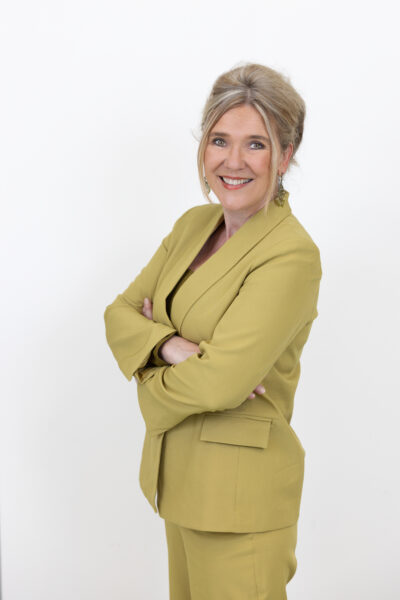
Jolanda Omvlee
Executive Director SeeYou

2025 1. Vision and mission

1
Vision and mission
Our motivation
Every human being is precious and valuable. So, we are deeply concerned when our fellow human beings with disabilities lack access to essential facilities and suffer injustice because of their disability.
Our mission
Equal access to eye care, healthcare, education and work for persons with disabilities in Africa and Asia.
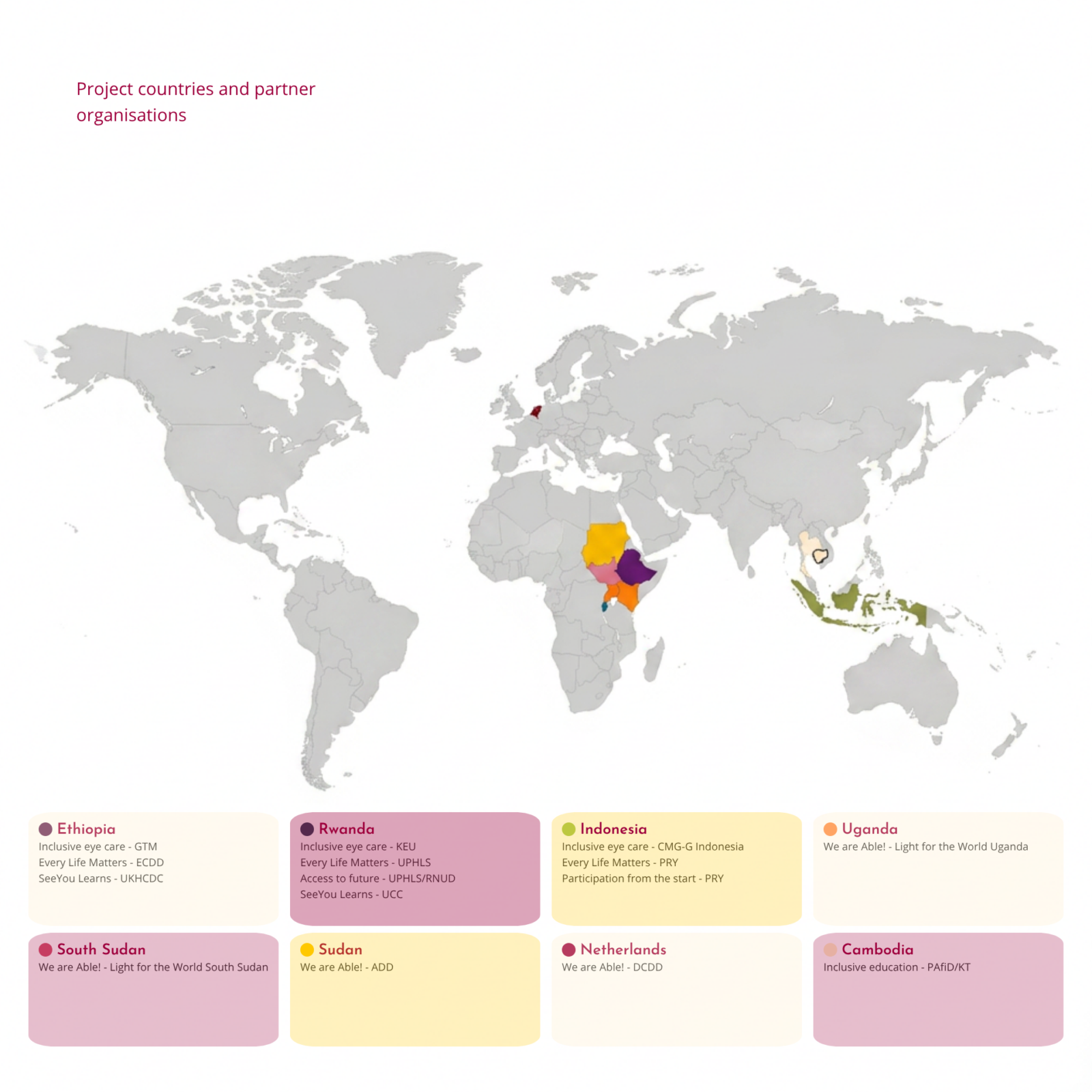
We work in seven countries – Ethiopia, Rwanda, South Sudan, Sudan, Uganda, Cambodia, and Indonesia – to prevent blindness, provide high-quality eye care and healthcare, ensure food security, and offer low-threshold education for persons with disabilities. We also seek inclusive communities for persons with disabilities in the above-mentioned countries.
We see ourselves as facilitators of inclusion by guiding, inspiring, coordinating, and mobilising. By doing this, we help persons with a (visual) disability stand up for equal rights and assist their advocacy groups in promoting their interests in dealings with the government. In the Netherlands, we also lobby for an inclusive development cooperation policy.
We are Able! was completed in 2025, and with that, our programme in South Sudan, Sudan, and Uganda came to an end. We will start new projects in Tanzania and Malawi in the coming years.
Our strategy in 5 themes
Last year, we launched our new multi-year strategy 2026-2030, titled “Stronger Together.” This captures the very essence of our approach in this new phase, where we emphasise the power of joint efforts, partnership, and solidarity. Only by working together can we achieve lasting change for persons with disabilities.
Read our full multi-year strategy (externe link)

We mobilise persons with disabilities and their advocacy organisations (organisations of persons with disabilities – OPDs), so they understand their rights and feel confident enough to stand up for them. SeeYou Rights is the driving force behind our four other strategic themes.
We improve access to high-quality and affordable eye care – especially for people at risk of preventable blindness – by investing in prevention, awareness, professionalisation, diagnosis, and treatment.
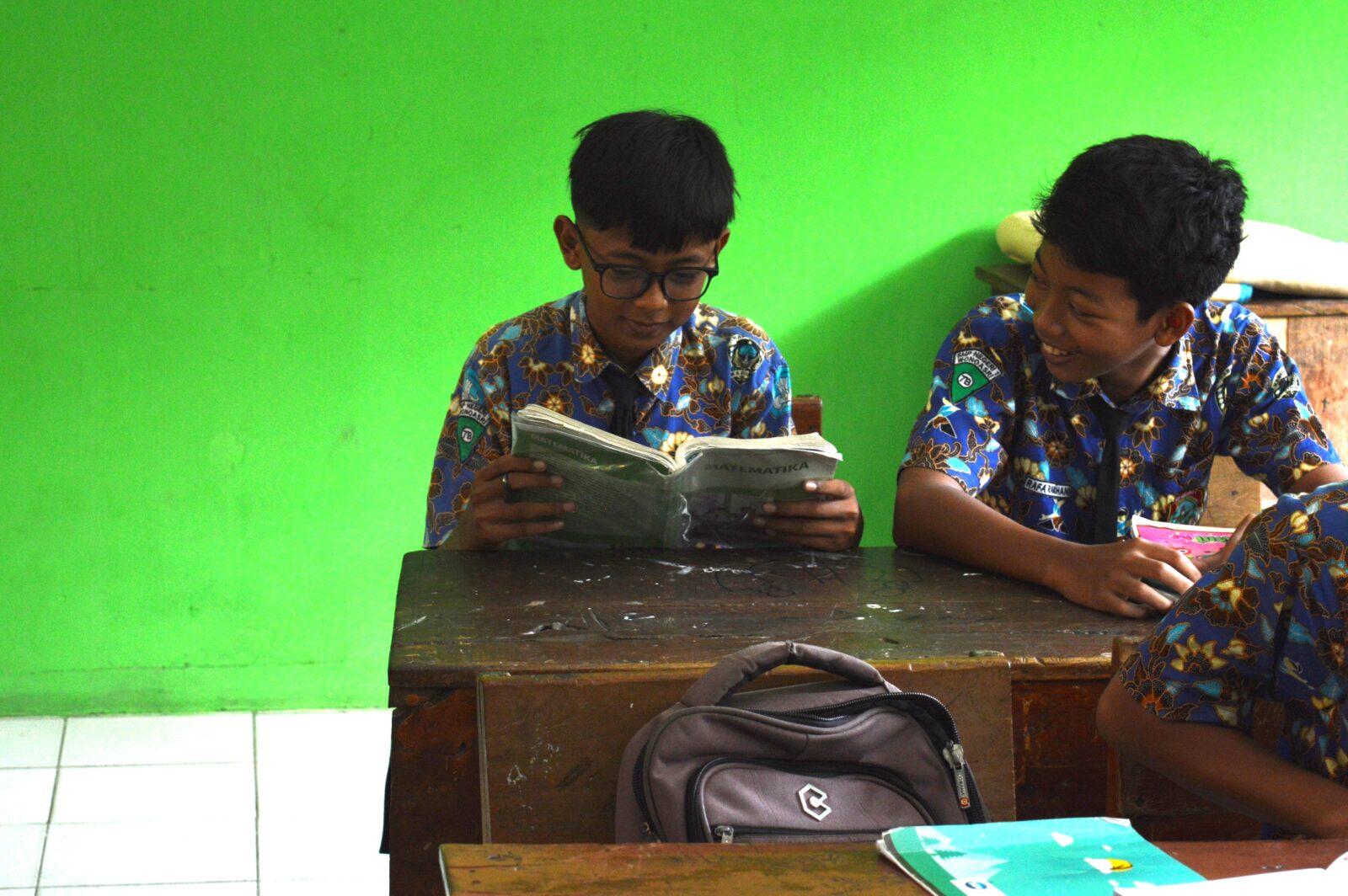
We strive to improve access to pre-school development and primary education for children with disabilities, for example, by developing inclusive teaching methods in cooperation with local organisations and schools.
We improve access to all forms of healthcare, mental healthcare, and medical information for persons with disabilities.

We want to make it possible for young persons with disabilities to develop their skills, work, and earn an income.
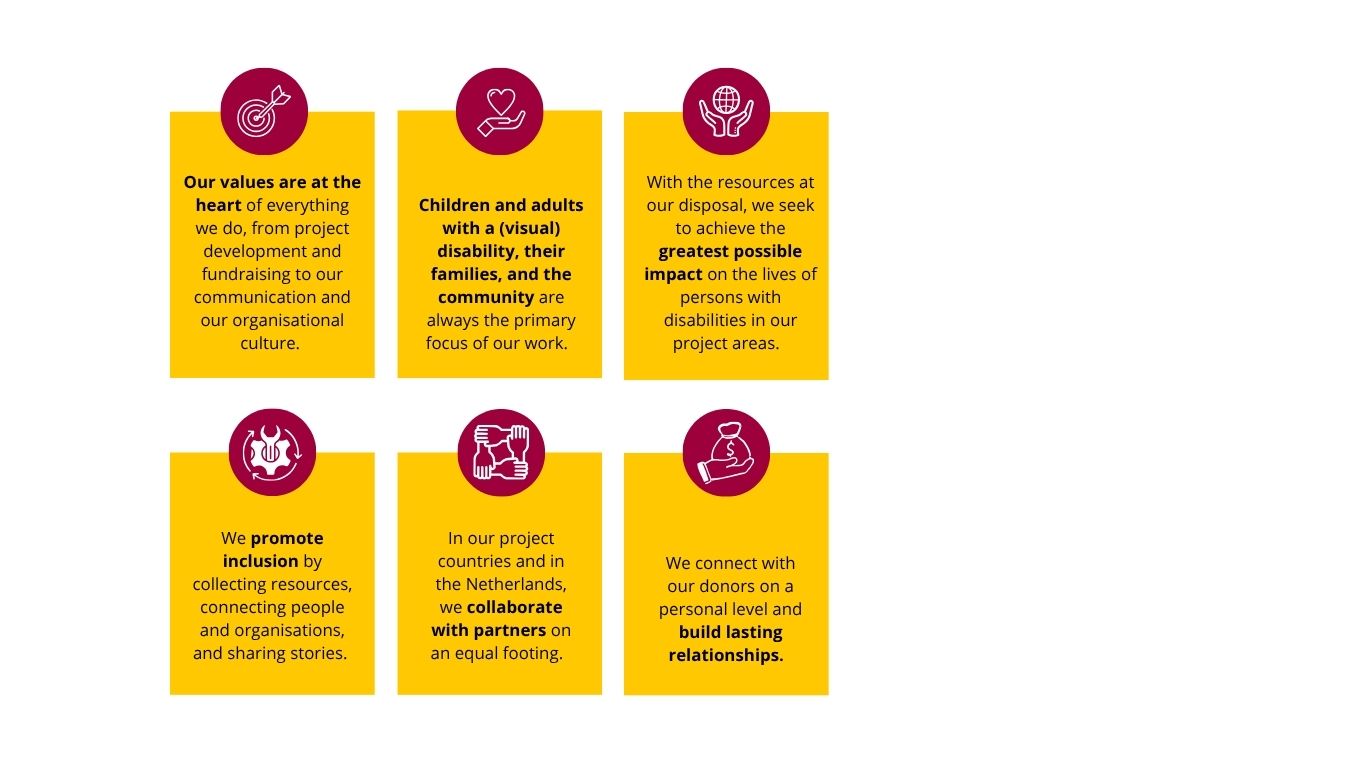
6 guiding principles

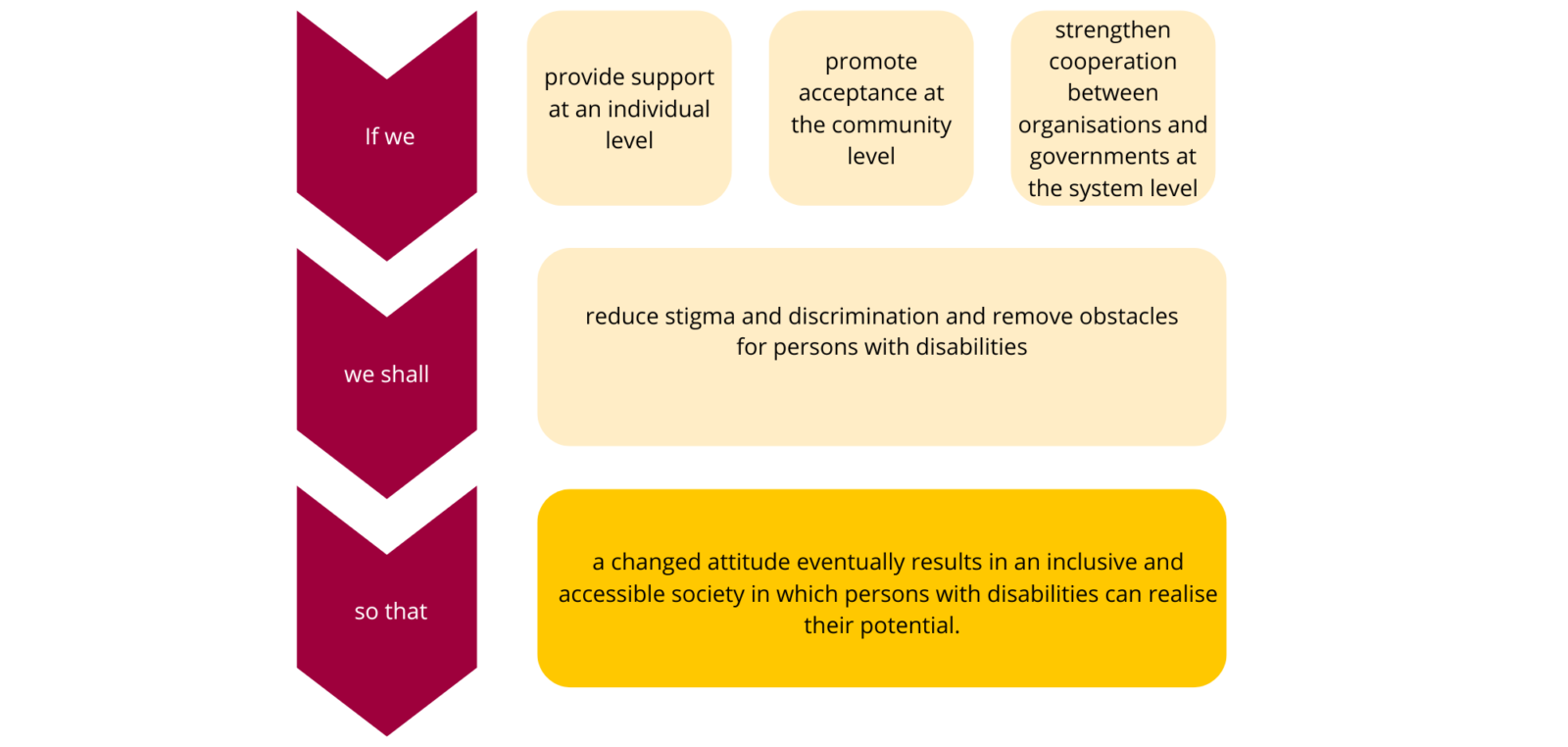
Our pathway to change


2025 2. Impact

2
Impact
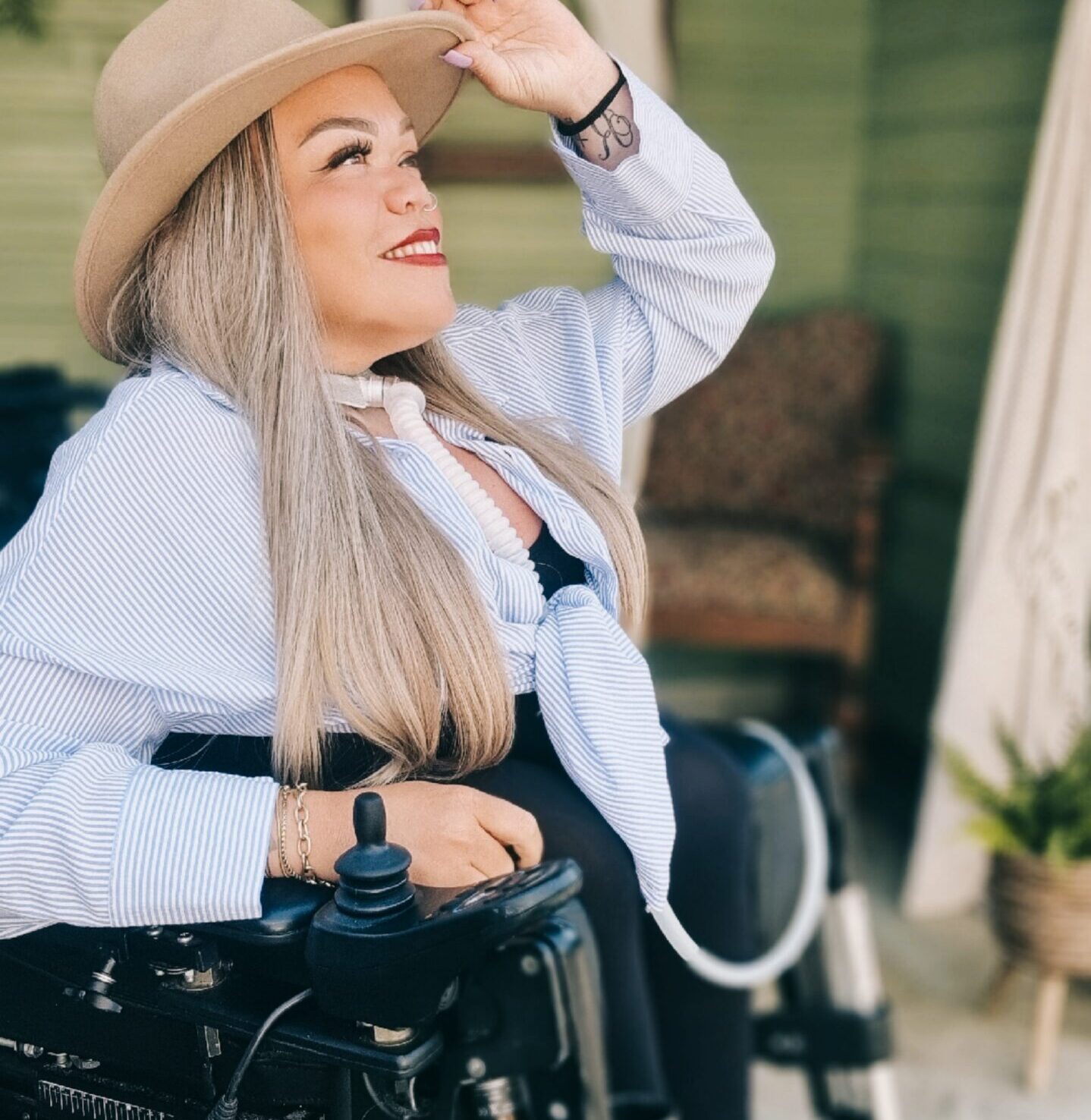

‘Healthy people are severely limited’
‘Having lived in a wheelchair for so long, I know better than anyone what it’s like not to be able to do something or to be misunderstood. So I can really relate to the stories told by SeeYou. I was five years old when I ended up in a wheelchair. Despite this, I used to play outside a lot with other children. I wish children with disabilities in other countries could have that freedom too; to be able to get about, go outside and join in the fun. Crutches, a wheelchair or a prosthesis can make such a difference to a child.
By sharing my story, I hope to support them. Because every child deserves the same opportunity. For me personally, inclusion means that we, as persons with disabilities, belong just as much as everyone else, with the same rights and opportunities as people who are healthy. For a very long time, I felt like a weakling, but that’s not the case. I’ve been fighting my whole life, but I’ve never let prejudice or what other people think of me hold me back. I’ve noticed that it’s actually healthy people who are severely limited. Because they have experienced little adversity – or have managed to avoid it. Unlike them, I did have to deal with adversity, and that has made me very resilient.’
Roos Botman became a SeeYou ambassador in 2025 and has been in a wheelchair for 33 years. She has a severe form of scoliosis. In addition, at the age of five, she also suffered a spinal cord injury due to a medical error during an operation, and she requires permanent respiratory support.
224649
eye screenings
26823
eye treatments
1044
people trained in eye care
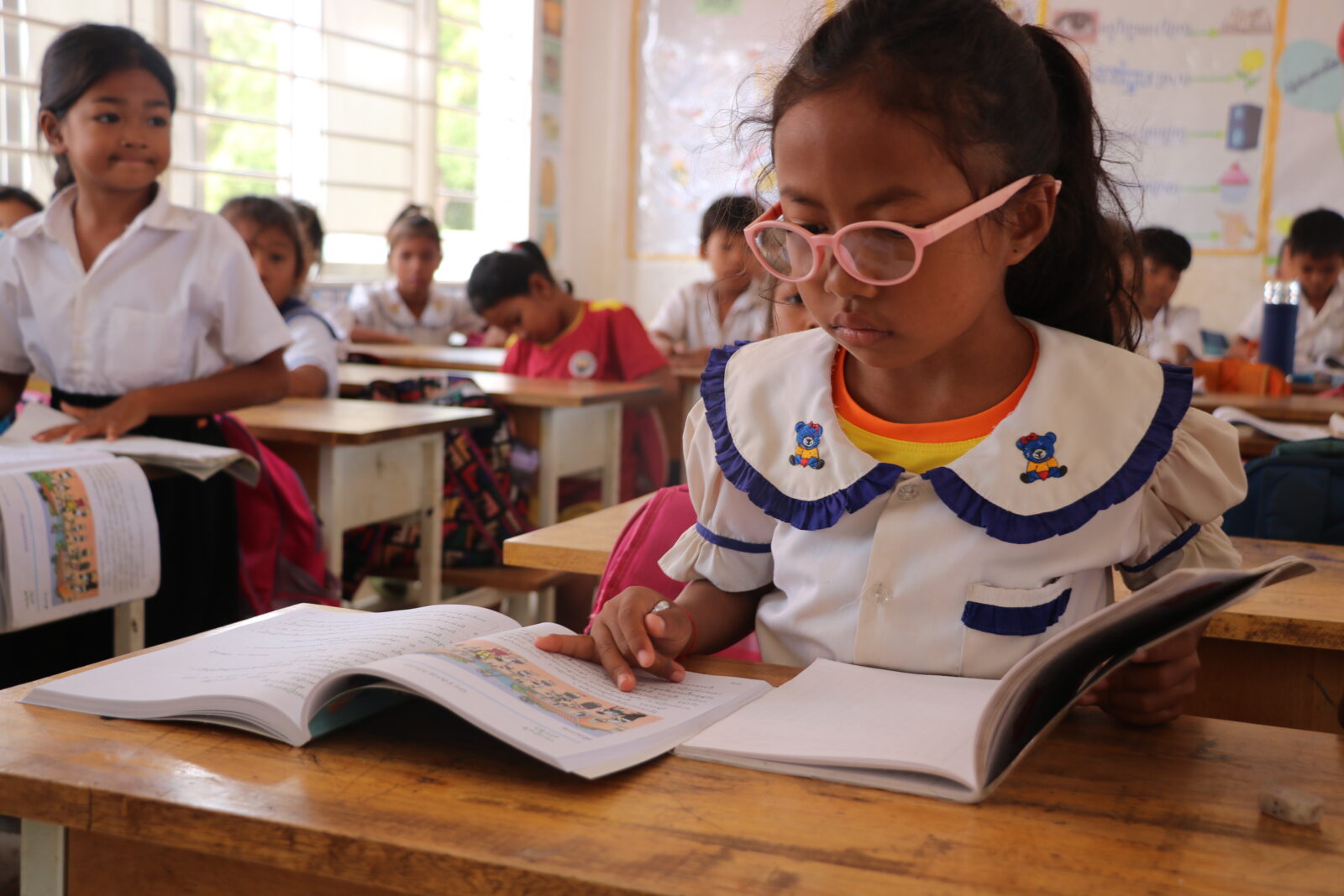

9322
adults and schoolchildren received glasses or other visual aids
92
teachers have been trained in inclusive education
Inclusive education for
629
children with disabilities
604
women with disabilities received training for work and income
Accessible healthcare for
10689
persons with disabilities

886
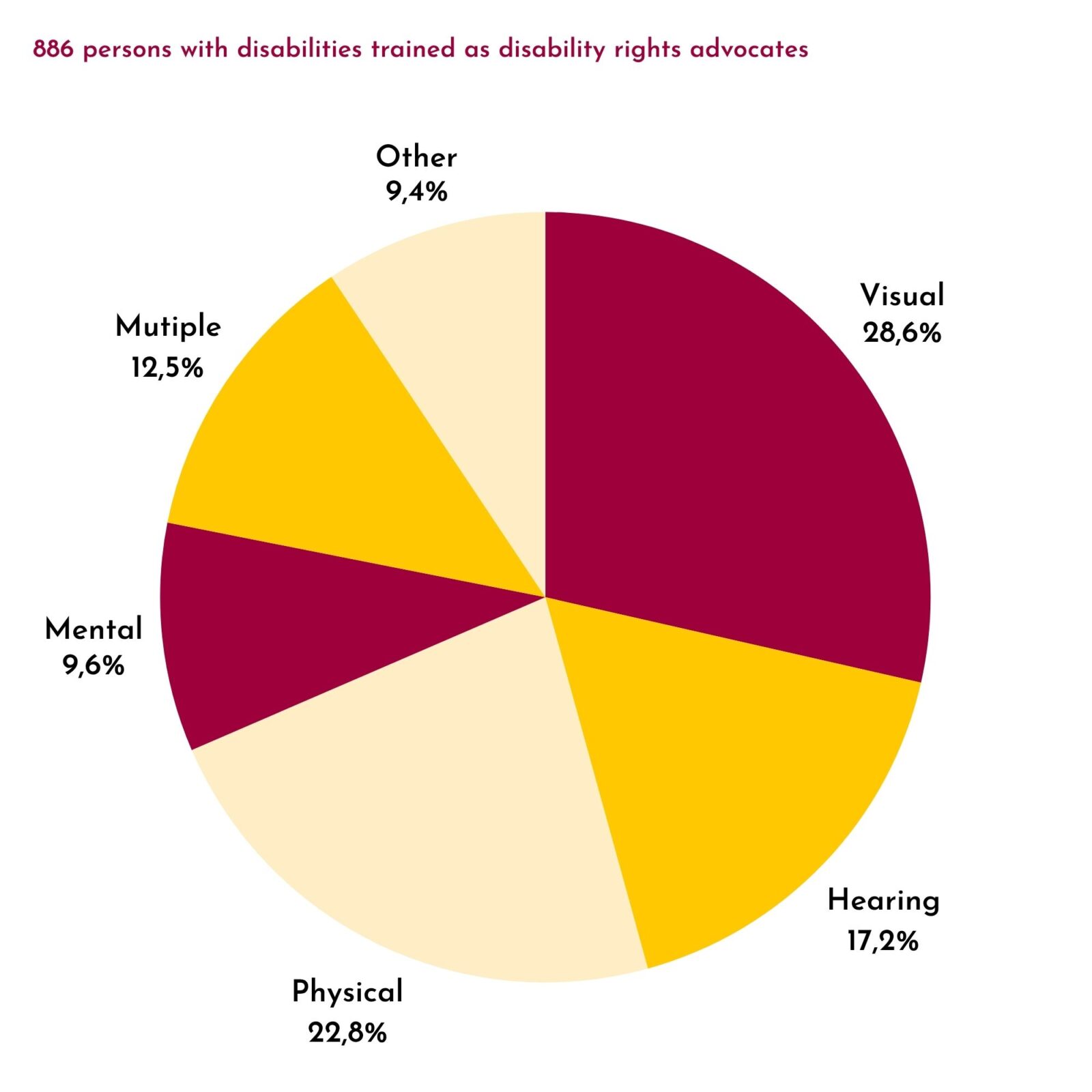
people trained as Disability Rights advocate
195
advocacy organisations for persons with disabilities strengthened
3231
people took part in an inclusion training
155402
people reached with awareness campaigns
2025 3. SeeYou Eye Health

3
SeeYou Eye Health
Improving vision with eye screenings, treatments, and assistive devices
Ethiopia
People in Butajira can now access low vision care. In this way, people with poor eyesight, night blindness or visual field problems received tinted glasses, a reading or writing stand, or a white cane. Thanks to a custom-made aid, an older man with impaired vision is once again managing his paperwork independently. This enables him to maintain his income and play a more active role in the daily life of his village.
Our partner GTM has taken significant steps towards greater professionalisation, efficiency and future-proofing its healthcare services by switching to a digital patient management system.
- The mobile outreach team made eye care accessible to patients in remote villages, where 45,134 adults and children received an eye screening and/or treatment.
- 3,936 people now have glasses or another visual aid, which improves their eyesight, daily functioning and performance at school or work.
- 685 patients were treated for serious eye conditions, such as advanced trachoma, thereby significantly reducing the risk of blindness.
- 17 new wells provide clean water to more than 6,000 people. Better hygiene reduces the risk of eye diseases. And women and girls who fetch water don’t have to walk as far, so they have time to go to school.
Teaching people to recognise eye problems themselves
Rwanda
As a result of information campaigns, awareness-raising, and training courses for teachers and healthcare workers, people in rural Rwanda are increasingly aware of how to recognise and treat eye problems. As a result, 32,152 children were screened, 18,803 people attended hospital consultations, and 10,846 people were treated for eye infections in district hospitals.
Thanks to capacity-building initiatives at local hospitals, eye care has increasingly become an integral part of existing healthcare provision. And if necessary, patients are referred to the KEU Eye Hospital for specialist care.
In early 2025, our partner KEU faced unrest in western Rwanda stemming from the conflict in Congo. Also, the Rwandan government blocked funding from Belgium, resulting in the loss of a donor, and costs rose due to high inflation. Thanks to a budget review and additional funding from SeeYou, KEU could even so continue to provide quality eye care services.
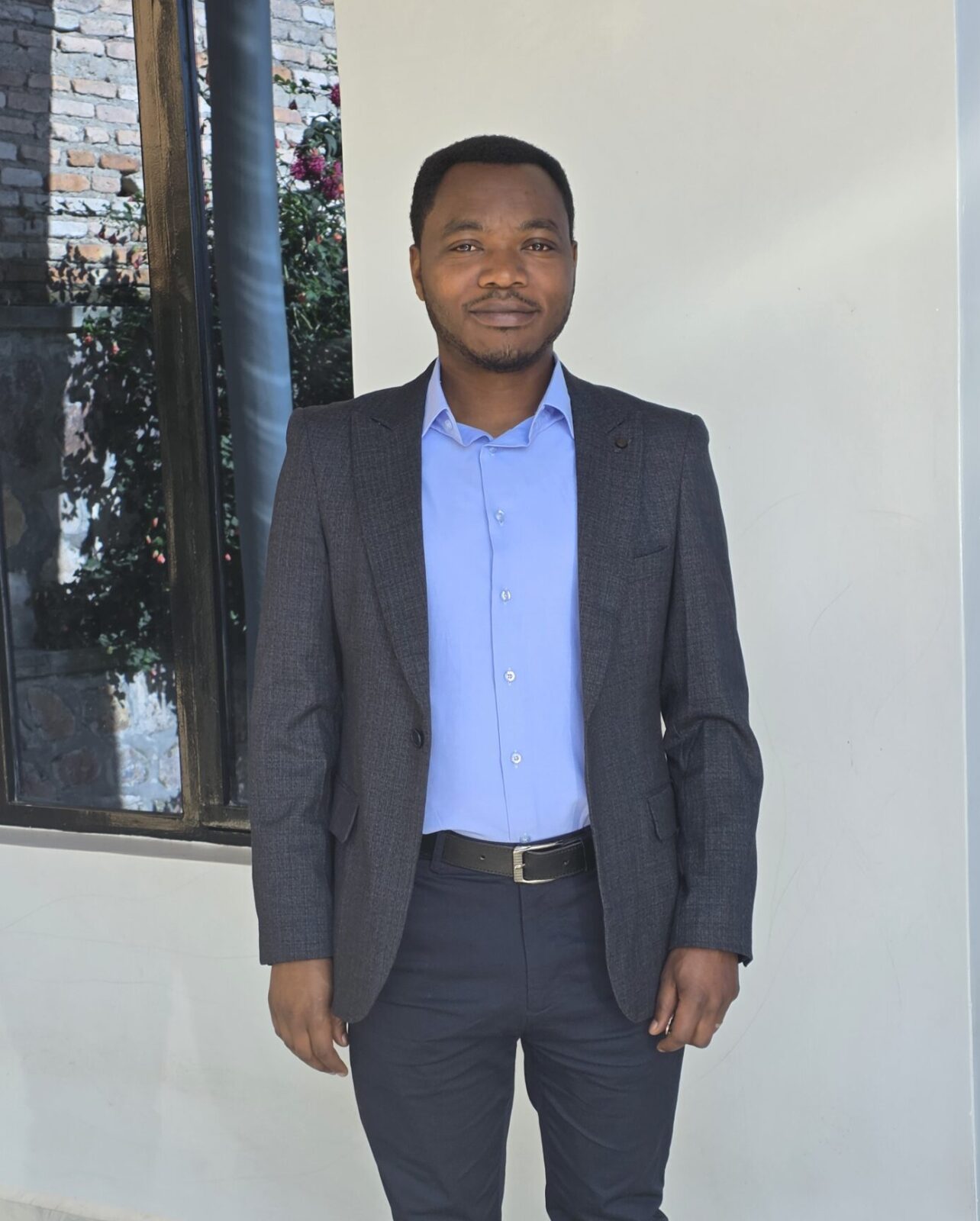

New director of KEU, Dr Livin: ‘50 people were waiting for cataract surgery’
Last October, Dr Livin Uwemeye took over the day-to-day management of the Kabgayi Eye Unit (KEU) from Dr Theophile. He studied ophthalmology in Tanzania with a scholarship from Light for the World Belgium and has been working for KEU for the past five years.
‘At secondary school, a friend of mine had trouble seeing. But he went to an eye clinic, and when he came back to school, he could see properly again! Then I thought, ‘If I can ever help someone to see again, that will be the greatest achievement of my career’. Now. I daily help patients with eye problems.
There is a great shortage of eye care, particularly in remote rural areas, where many vulnerable people live. Fortunately, more and more people are finding their way to our hospital. At the same time, this also means an increase in the number of people who require financial support. Glasses, for instance, are very expensive compared to average incomes here, and poorer segments of the population certainly cannot afford them.
The first time I went on an outreach trip, more than 50 people were waiting for cataract surgery. Just by looking at the number of people we’ve been able to help and train as well over the past few years, I can see how much of an impact SeeYou has here. I am very grateful to SeeYou on behalf of all the poorer patients who can now see again.’
Focus on eye care on Java
Indonesia
In the smaller villages on Java, there is limited knowledge of eye care and the options for preventing and treating eye diseases. However, working alongside CBM-Global Indonesia, we could further improve access to eye care and the early detection of eye problems through prevention, treatment and collaboration with local authorities and organisations.
- Five hospitals received new surgical instruments for cataract operations, and 937 people underwent cataract surgery.
- 29 teachers have now been trained to identify eye problems in pupils at an early stage. Thanks to their efforts, 29,308 children were screened and 1,121 pupils – such as Jelita – received glasses or other visual aids.
- 1,169 adults received glasses or other visual aids to improve their eyesight, enabling them to once again participate fully in daily life.
- New agreements between advocacy groups and schools, local health organisations, and churches regarding independent eye screenings conducted by teachers form the basis for a potential partnership agreement among government bodies within the School Health Programme.
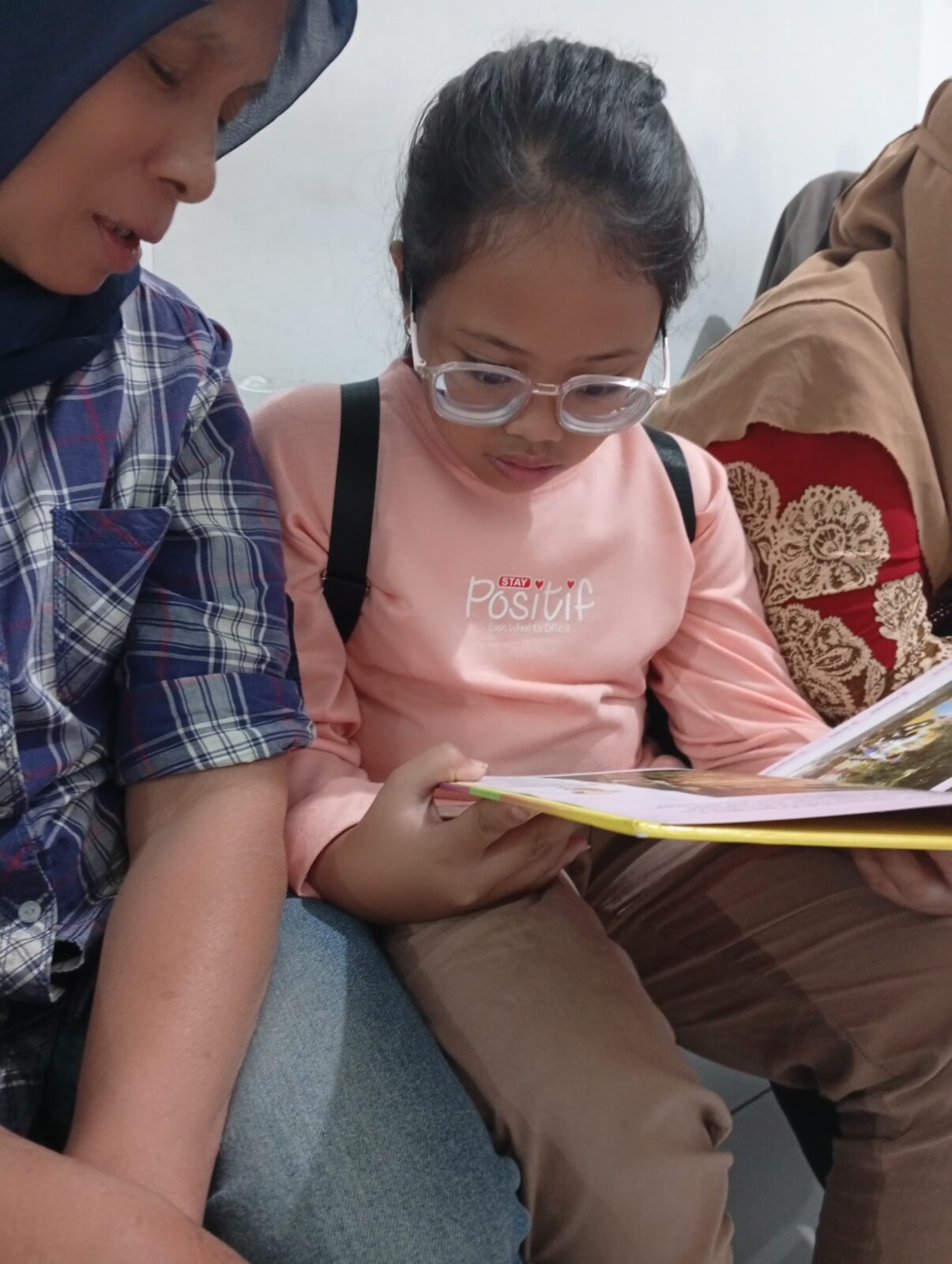

Jelita receives a pair of glasses that changed her life
Nine-year-old Jelita lives in the Indonesian village of Magetan. After losing her mother, she is now growing up with her father, who is barely able to work due to a head injury, and her grandparents. The family lives on her grandmother’s income and has no health insurance.
Due to severe short-sightedness and a lazy eye, Jelita could barely read the blackboard. She was dependent on a classmate to keep up with the lessons. Her self-confidence plummeted, but medical help seemed out of reach because the costs were simply too high.
Her problem was discovered during an eye screening at school. As the family had no insurance, the doctor contacted the I SEE Team straight away. Through the I SEE project, she was granted access to a medical examination and was given a pair of glasses.
When Jelita put on her new glasses, a whole new world opened up to her. Jelita can now see the blackboard, actively participates in class and is playing with her friends again. Her grades are improving, and her self-confidence has returned. Jelita: ‘Something so small has a huge impact on people with visual impairments.’
In 2026, we will launch a SeeYou eye care project in Tanzania. We are entering into a partnership with the Kilimanjaro Christian Medical Centre. This hospital has a specialist ophthalmology department and trains eye specialists from Tanzania and neighbouring countries.
2025 4. SeeYou Learns

4
SeeYou Learns
Sustainable change through a three-tiered approach
Rwanda
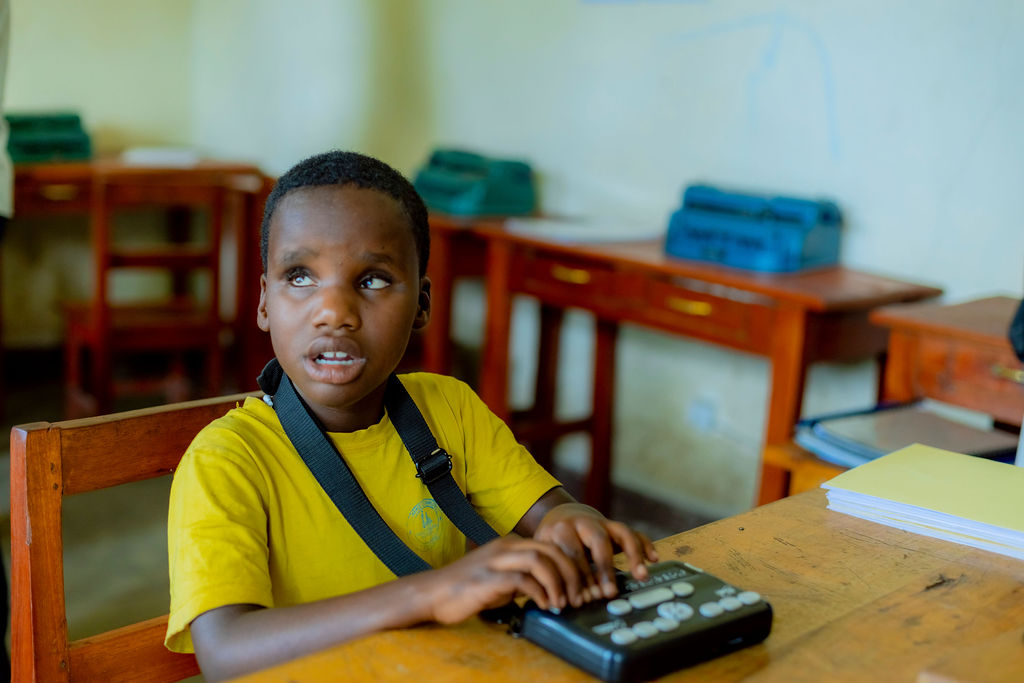
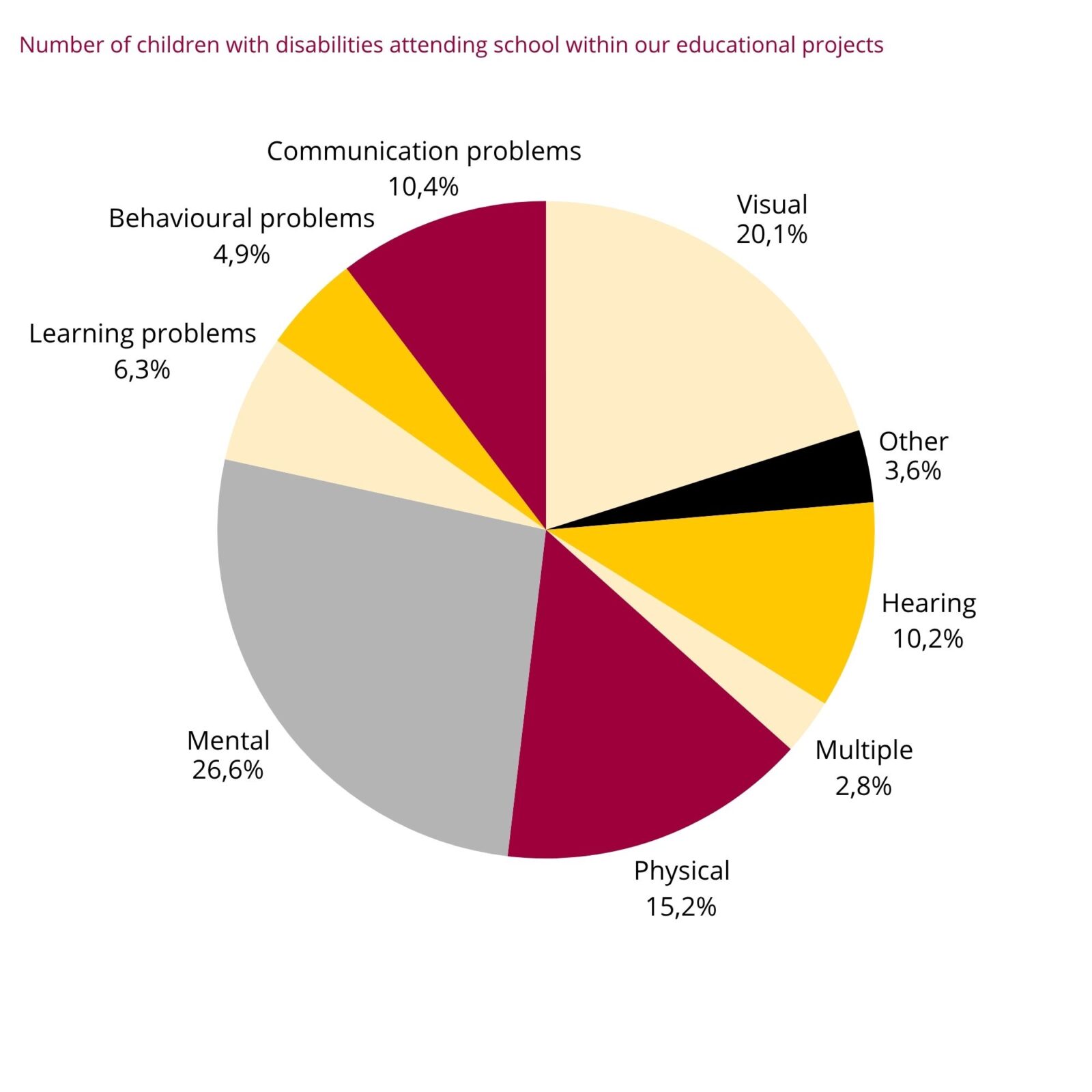
We are proud of the results from the SeeYou Learns pilot in Rwanda, which is realising lasting change for children with disabilities through a three-tiered approach: at home, at school and in the community. Together with our partner UCC, we support 30 children – 19 with disabilities and 11 with a family member who has a disability – and their families.
- All 30 children received uniforms, (adapted) learning materials such as Braille teaching materials, medical care, and a daily breakfast and lunch to combat malnutrition and improve their concentration and physical development. School fees and transport were also taken care of to remove any potential barriers that might have prevented the children from attending school.
- The parents of these children received practical training. They say they now understand their children better and can offer them more targeted support. They also set up a savings group to improve their financial situation and invest in their child’s school career.
- 51 local leaders, care workers and coordinators from the National Council of Persons with Disabilities received training on topics including Down’s syndrome, albinism and spina bifida. They now feel better equipped to identify children with disabilities and support their families.
- 12 school directors and teachers received training on inclusive education and reported having greater knowledge and confidence in applying inclusive teaching strategies.
This pilot project, launched in 2024, was so successful that we extended it through to the end of 2025. We will now continue it with a multi-year follow-up project. In this follow-up, we are also supporting 45 children and their families in Musanze, where UCC has opened a new school for inclusive education.
Border conflict in the Democratic Republic of the Congo (DRC) also affects UCC
On 27 January 2025, fighting between the rebel group M23 and the DRC’s national army spilt over from Goma (in the DRC) to Gisenyi (in Rwanda). The bullets landed on the other side of the border and mainly hit the neighbourhood where the UCC’s Home of Children School is located. Several buildings were damaged, and the inclusive workshop for young people was so badly damaged that it could no longer be used. We launched a short-term emergency aid project to repair the damage to the buildings.
Inclusive pre-school education
Indonesia
Our partner, Pusat Rehabilitasi YAKKUM (PRY), provides inclusive education to 27 children at its own nursery school. And, as a centre of expertise, they share their knowledge with parents, teachers and care workers, support 88 pupils at other schools and promote an inclusive attitude among local communities.
- Inclusive education has a positive impact on all pupils. Children with disabilities are increasingly participating in classroom activities, learning basic skills and becoming more sociable. At the same time, the 250 children without disabilities show greater empathy and actively help their classmates.
- A mobile specialist team offered children the medical care that would otherwise have been inaccessible or too expensive. This care includes speech therapy, physiotherapy and psychosocial support.
- Parents, teachers, and volunteers from local health centres were trained to better support children at home and at school. This led to noticeable improvements in the pupils’ speech, motor skills and social behaviour.
This three-year project will run until March 2026. In preparation for the next phase of the project, PRY is developing a business plan to achieve financial independence for the nursery school.
New! Education project for 1,200 children
Ethiopia
Our new five-year education project in Ethiopia began in April 2025. Together with our Christian partner, the Ethiopian Kale Heywet Church – Humanitarian Aid and Development Commission (EKHC-HADC), an expert in the field of education, we will be working towards three goals over the coming years, because every child is of equal value:
- 1,200 children with disabilities or developmental delays can attend school and receive an education tailored to their unique needs, thereby improving their well-being and future prospects.
- 30 schools and local communities are becoming more inclusive through greater involvement and improved skills. In this way, we work both within each child’s immediate and wider environment to bring about lasting change towards inclusion in society.
- Organisations for persons with disabilities and local authorities support and promote inclusive education through local policies.
Just one year into the project, 243 children with disabilities – who previously did not attend school – now go to school.
Education for children with a visual impairment
Cambodia
2025 marked the final year of the project and our collaboration in Cambodia with our partner, People’s Action for Inclusive Development (PAfID). Together, we worked to promote inclusive education for visually impaired children. PAfID focuses on local collaboration, trains teachers in pedagogical skills to teach pupils with visual impairments, and raises awareness about inclusion. Limited resources for teaching aids and the practical implementation of inclusive teaching methods can sometimes be challenging. However, thanks to PAfID’s collaboration with local authorities and the Ministry for Education, Youth and Sports, inclusive education will continue to be developed in the future.
- 189 pupils received an eye test.
- During school visits in four provinces, 37 teachers received technical support, and the care for 51 pupils with visual impairments was monitored.
- 25 teachers received training, which improved their skills and, subsequently, had a positive impact on their pupils’ academic performance.
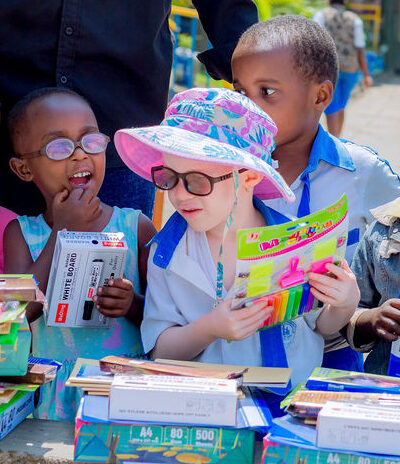

‘SeeYou Learns has given me hope for and confidence in my children’s future’
Francine has three children. Two of them, including her youngest daughter Davilla, were born with albinism. ‘There were a lot of misconceptions about albinism in my community’, recounts Francine. ‘As a result, we were discriminated against and excluded. Even my own family blamed me for causing this condition. My five-year-old daughter Davilla is visually impaired, like many people with albinism, which meant she couldn’t read the blackboard and was bullied at school.’
Fortunately, someone told her about the UCC support centre. Francine: ‘Since Davilla was admitted there, a lot has changed: SeeYou Learns covers her school fees, provides meals, learning materials and transport. My daughter was given a pair of glasses, which helps her see and learn better. Davilla is doing much better at school now!’
Home visits by the project team have changed people’s attitudes in the neighbourhood; there is now greater understanding and acceptance. ‘Thanks to the training, I’ve learnt how to support my children better and stand up for their rights.’

2025 5. SeeYou Works

5
SeeYou Works
Women with disabilities develop entrepreneurial and leadership skills
Rwanda
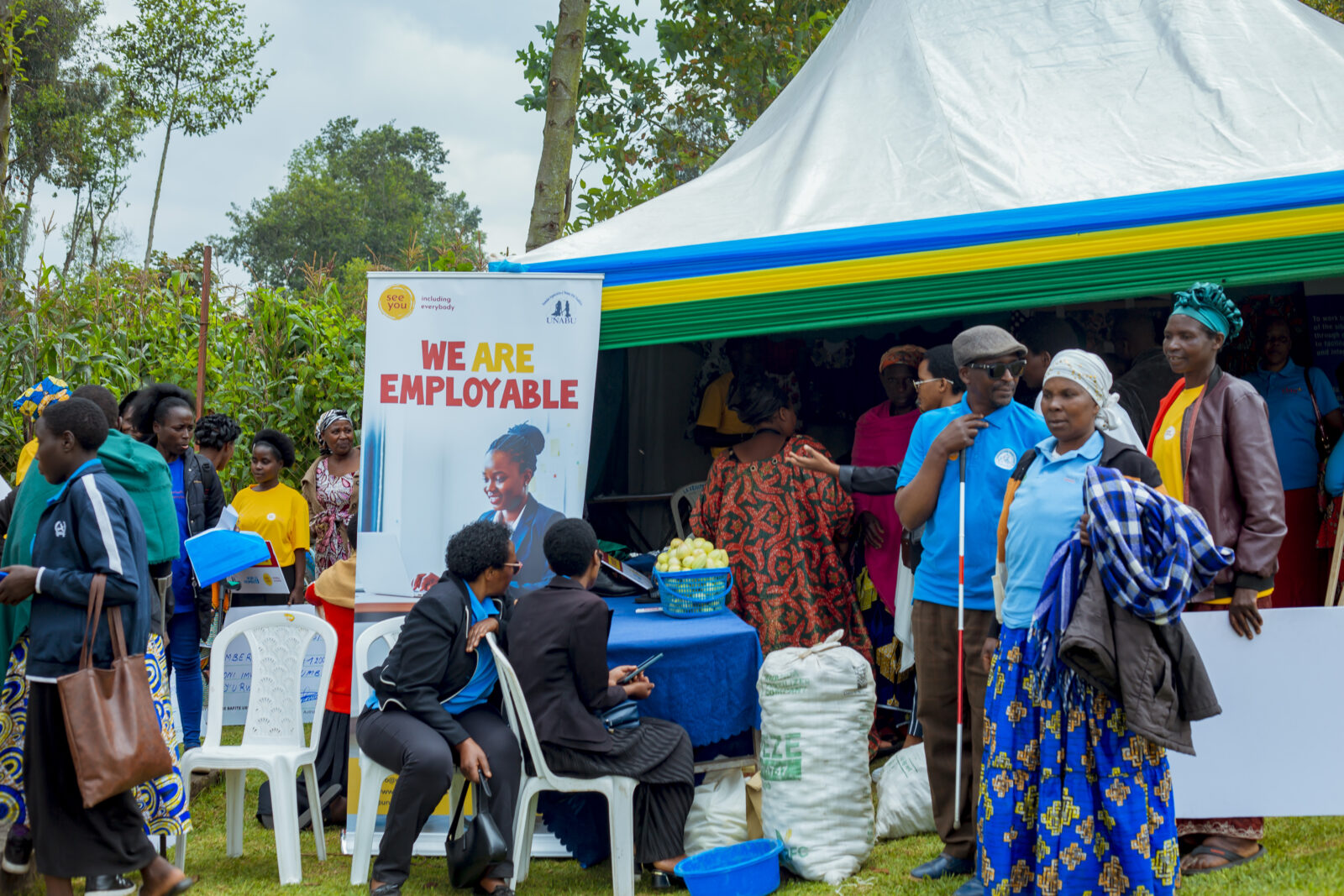
EmployAble supports girls and women with disabilities in the districts of Nyabihu and Bugesera in accessing education and employment, by combining individual support with systemic change.
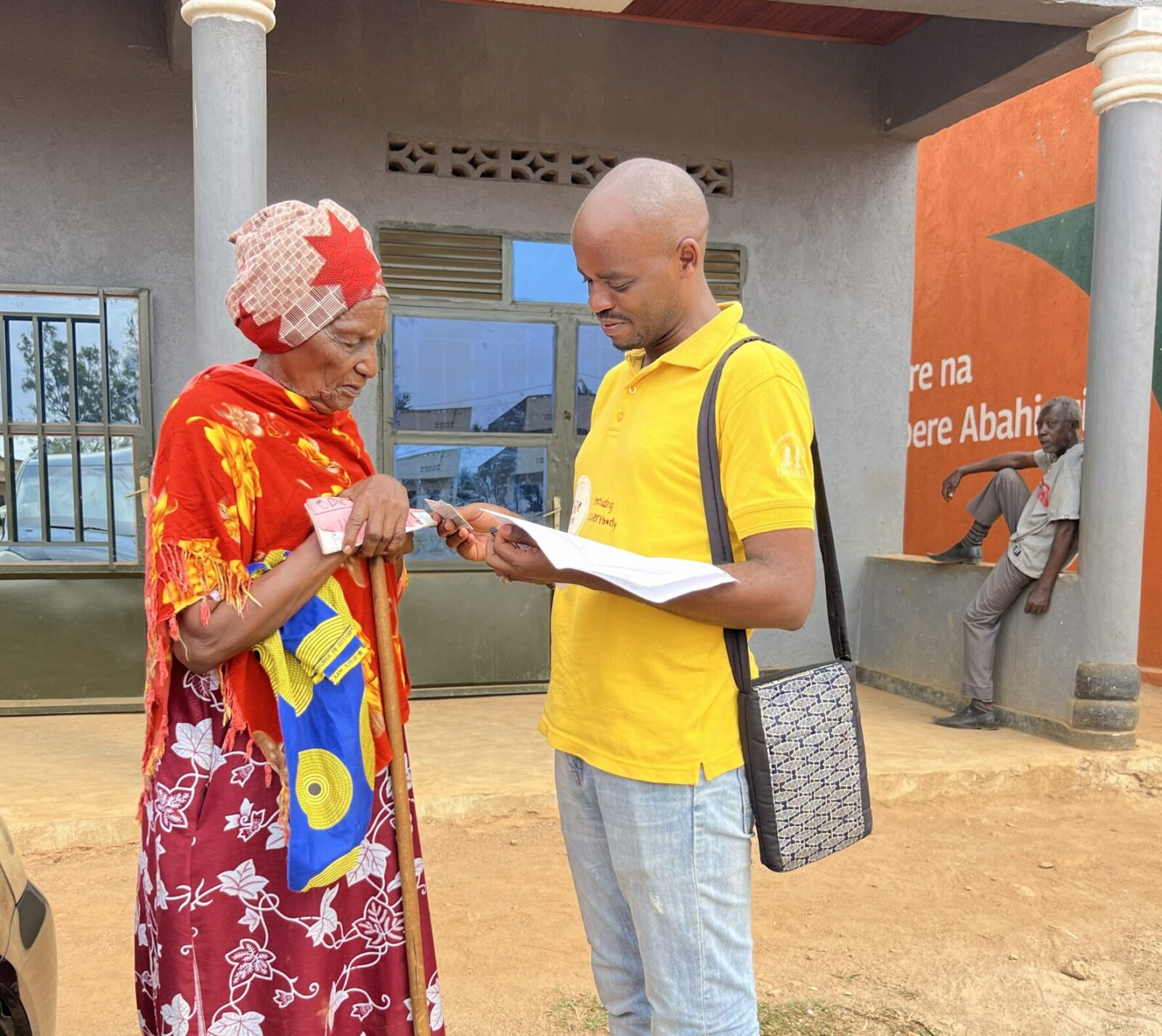
- Our partner UNABU works closely with vocational colleges, employers and local authorities to remove structural barriers. This resulted in 185 young women with disabilities enrolling in vocational training courses and 10 girls returning to mainstream education, two of whom are studying at a university.
- Support was provided to 123 existing groups comprising 2,601 girls and women with disabilities, as well as 38 new groups. Through training, coaching and learning from one another, they develop self-confidence, leadership skills and an entrepreneurial spirit. They learn to stand up for their rights and combat gender-related violence.
- 345 women with disabilities received training in finance and entrepreneurship. 15 groups of women received start-up capital so they could earn an income through, for example, livestock farming, sewing, or working as hairdressers. As well as improving their financial situation, this also boosts the women’s self-confidence and social inclusion.
- At the community and national levels, UNABU helped raise awareness and shape policy, which resulted in the establishment of a Network for Disability-Inclusive Employment.
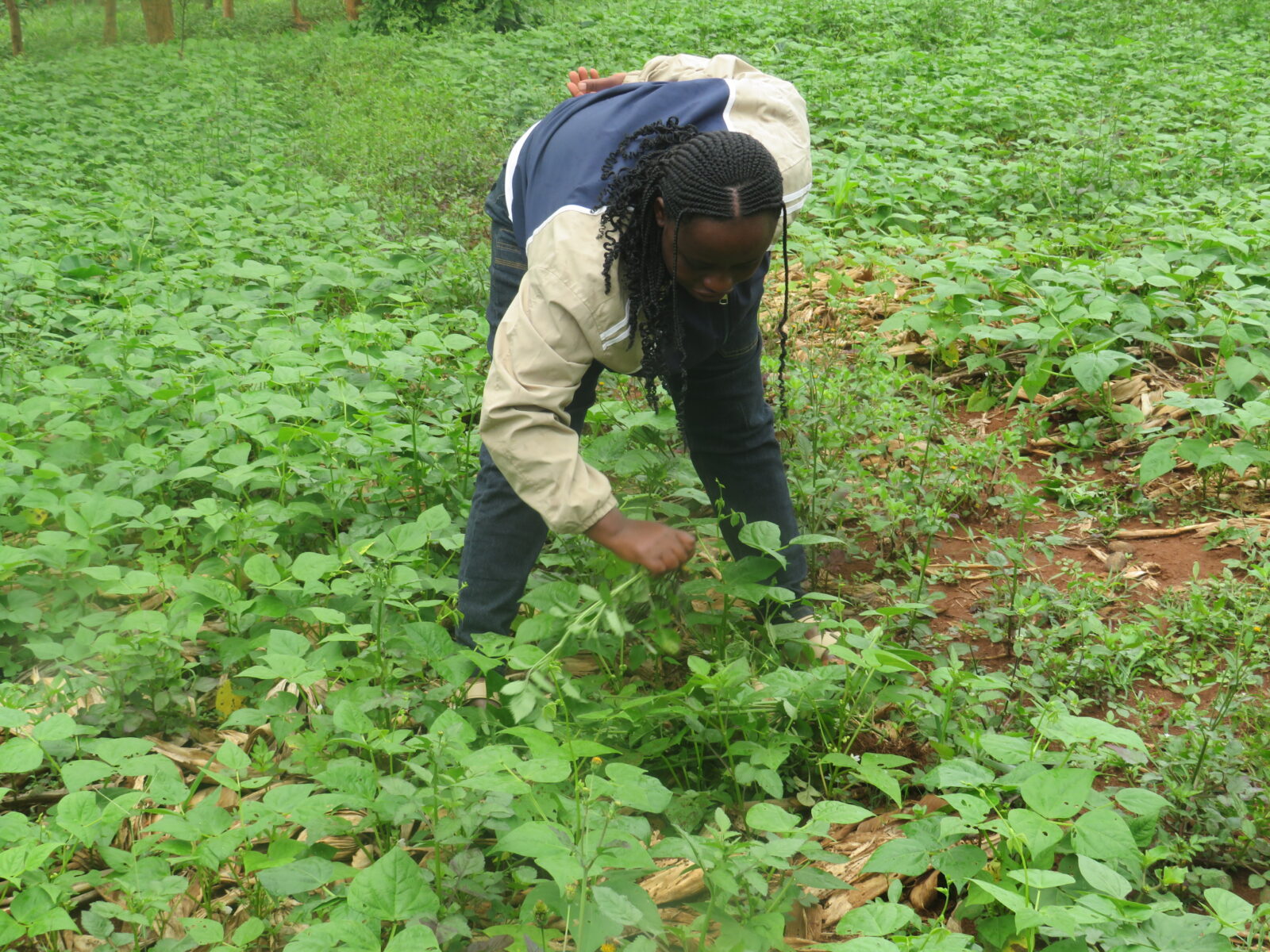

‘My harvest has tripled!’
Agripine lives with a visual impairment. Since her mother passed away, she also looks after her five younger brothers and sisters in addition to caring for her own child. As an active volunteer in her community, she took part in a UNABU workshop. There, she learnt both to raise awareness of the challenges faced by young persons with disabilities and to adopt new farming practices.
After the workshop, she quickly put her new knowledge and techniques into practice and expanded her farm to include tomato and fruit cultivation. Agripine: ‘Thanks to the workshop, I learnt that farming isn’t just about hard work, but above all about applying the right knowledge. When I came home, I changed the way I grew beans and maize, and my harvest has tripled. This has changed my family’s life.’
As a young woman with disabilities, Agripine found the confidence to play an active role in agriculture and to continue her volunteer and advocacy work.
2025 6. SeeYou Cares

6
SeeYou Cares
Accessible healthcare and less stigma
Ethiopia
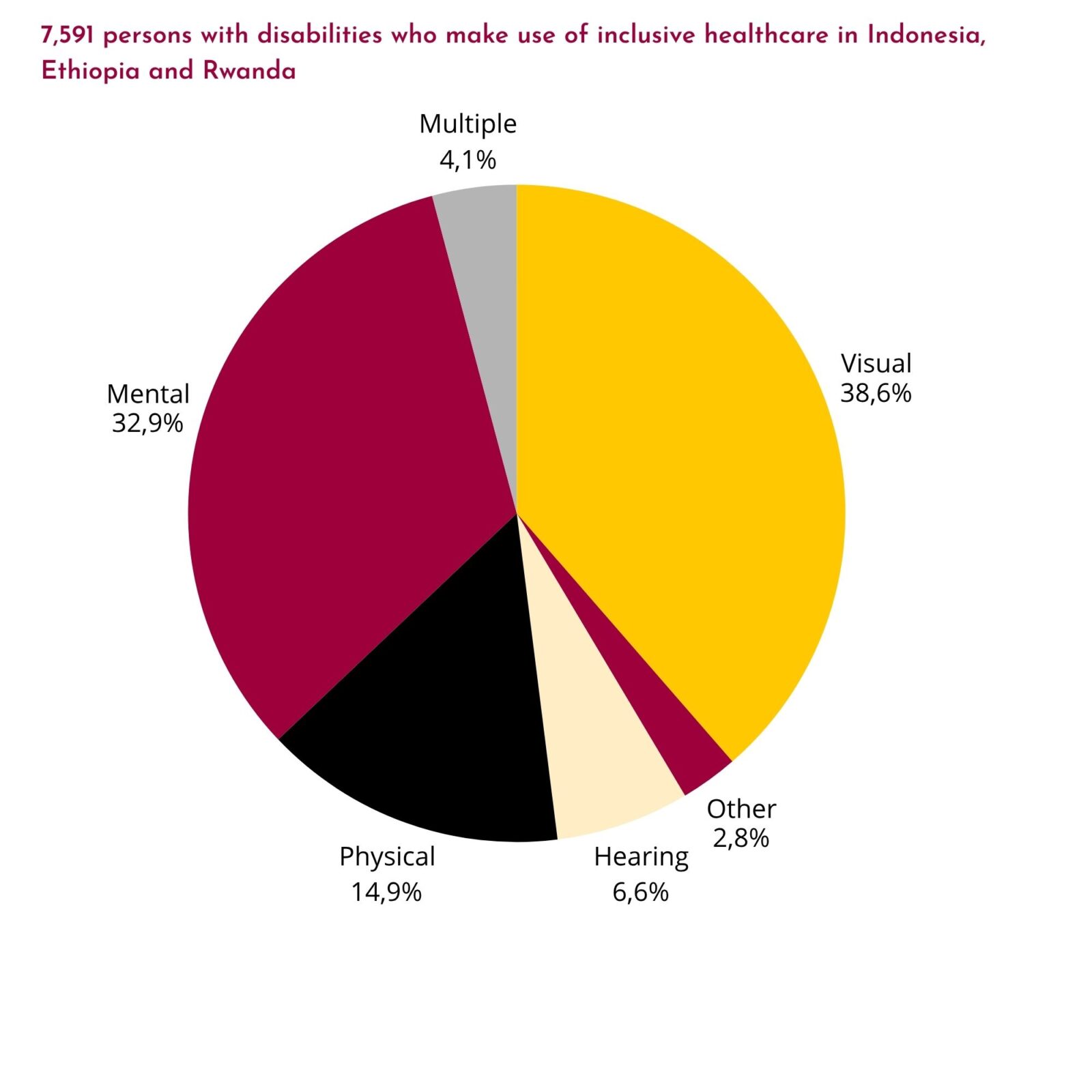
Every Life Matters in Ethiopia is committed to providing accessible medical care and sexual and reproductive healthcare (SRH) services for persons with disabilities. For example, wheelchair ramps and accessible toilets make a healthcare building physically more accessible. Whereas training, raising awareness, discussions about menstrual health, and influencing policy help to reduce stigma. Figures from our partners show that an increasing number of persons with disabilities are using healthcare services: 11,132 in 2025 compared with 7,871 in 2024.
- 977 women and girls with disabilities received information on sexual and reproductive health during coffee breaks.
- 136 people received financial assistance towards their medical expenses.
- 165 healthcare workers took part in an awareness-raising training on inclusion, and the Washington Group Short Set on Functioning (externe link) (WG-SS) provided a six-question brief screening tool for physical and mental disabilities, designed to enable rapid identification and referral.
Inclusive healthcare for mothers
Rwanda
In five districts across Rwanda, our partner UPHLS is working to provide inclusive healthcare for mothers and children with disabilities. By reducing discrimination and stigma – including among the women themselves – women are more likely to access healthcare services and feel more confident doing so. By 2025, the number of persons with disabilities receiving care from our partners had doubled: from 1,497 in 2024 to 3,445 in 2025.
- Poverty, a lack of information and transport problems are the main barriers to accessing healthcare. Through awareness-raising sessions for mothers, training for care workers, discussions with villagers and lobbying local authorities, Every Life Matters is committed to social inclusion.
- 10 care centres were equipped with a screening tool to identify disabilities in children at an early age. Data were collected from 1,601 children, ranging from newborns to 6 years of age, to ensure timely support could be provided where necessary.
Focus on mental health in 40 villages
Indonesia
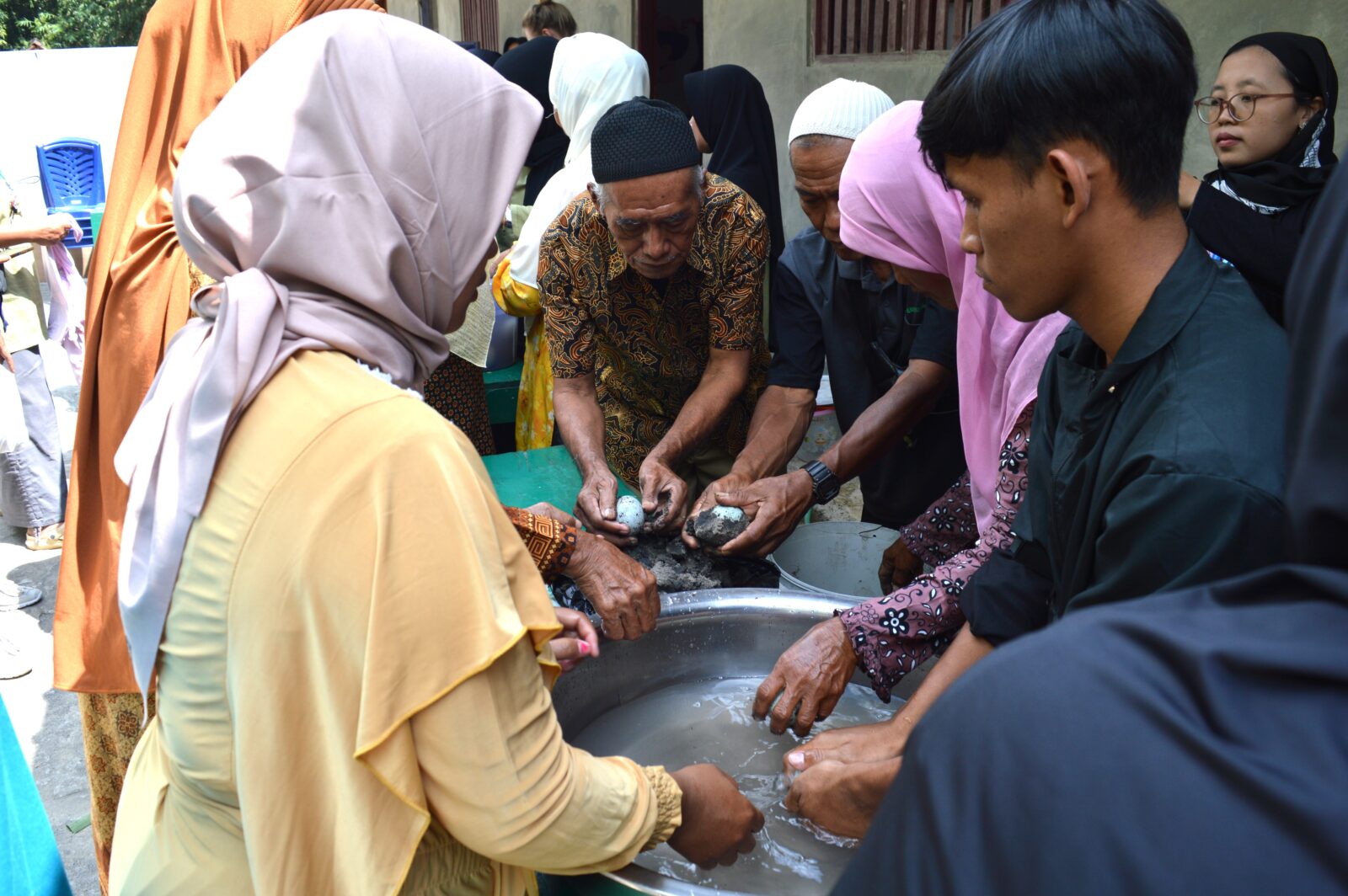
Thanks to Every Life Matters, the situation of people with psychosocial disabilities has improved in 40 Indonesian villages. By actively involving the community, a more inclusive care system was created in which everyone – from family members and volunteers to village councils and primary care providers – shares responsibility.
People with psychosocial disabilities developed greater self-confidence and gained more control over their lives. They took part in village activities and, for the first time, gave direction to their own recovery. At the same time, organisations representing persons with disabilities were given a greater role in local decision-making: they contributed their lived experience, helped to shape priorities and assisted in identifying barriers and stigma.
This project demonstrates that sustainable improvement is possible when the community, the healthcare sector, and the government together invest in accessible, dignified, and stigma-free mental healthcare.
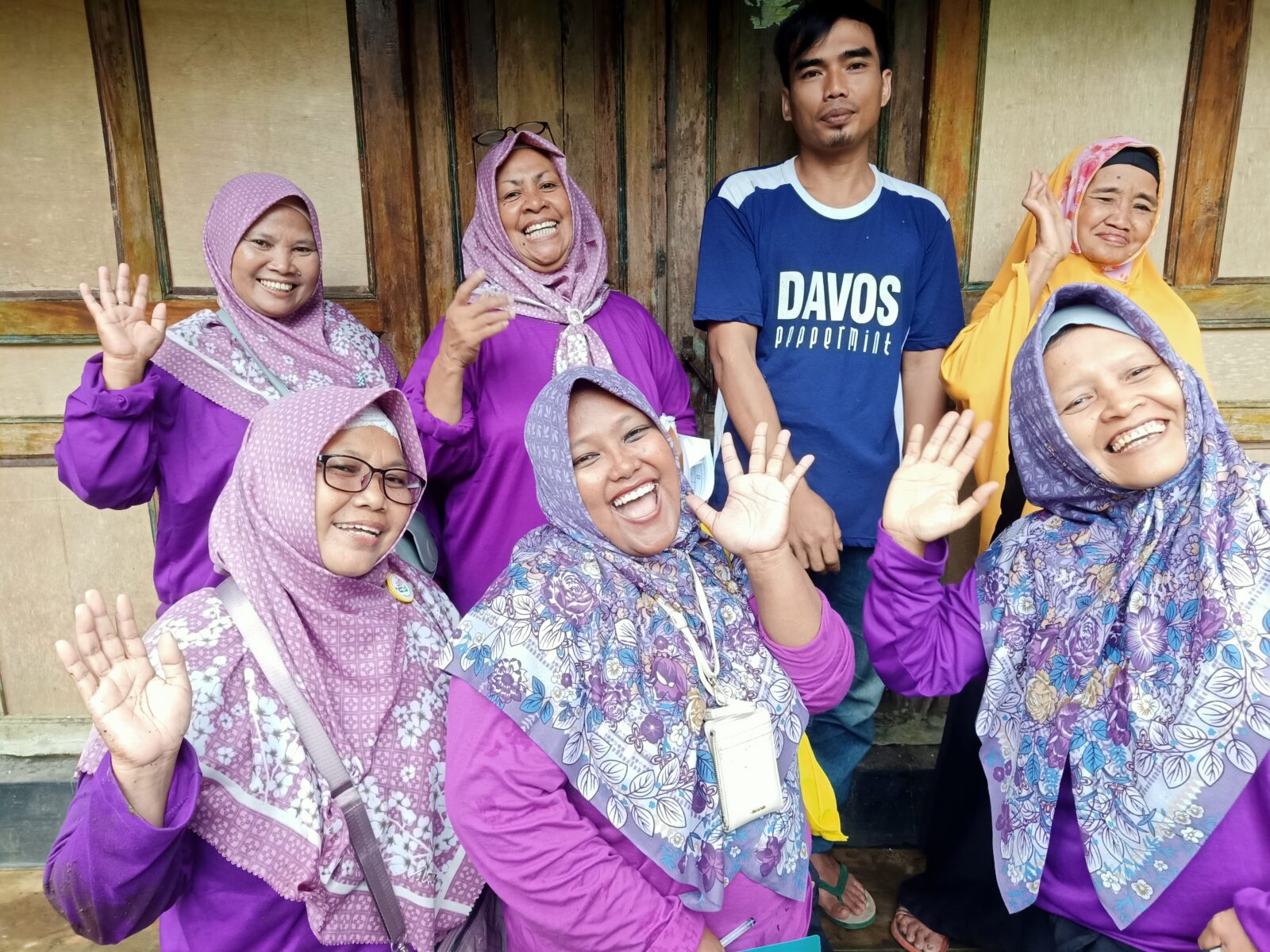

Sari Jiwa: volunteers who never give up on anyone
In the Indonesian village of Kedungsari, five volunteers have formed the mental health group Sari Jiwa. They support 15 people with psychosocial disabilities and their families, guided by compassion and the belief that everyone deserves to live a dignified life.
Their approach works. Thanks to Sari Jiwa, Nur Arofah was able to access medical care and health insurance. She now runs her own little shop and is fully involved in village life. And Ngadul Chakim now takes his medication regularly, looks after himself better and is actively involved in village activities.
Sari Jiwa also organises group outings and raises awareness about inclusive transport and mental health. A year on, the difference is clear: in the village, people with psychosocial disabilities experience less stigma, greater understanding and a stronger sense of inclusion. Volunteer Sri Hartati sums it up simply: ‘If we don’t do it, who will?’

2025 7. SeeYou Rights

7
SeeYou Rights
Five years of We are Able!
South Sudan, Sudan and Uganda
2025 marked the final year of the five-year We are Able! programme. In this programme, we collaborated with other organisations, persons with disabilities, their advocacy groups, and local authorities to promote equal rights, inclusive policies, food security, and livelihood security in South Sudan, Sudan, and Uganda.
Five years on, we can see that, in addition to improved food security and higher incomes, the programme has also resulted in more respect, equal opportunities, and structural change. Persons with disabilities have become more visible, better organised and more actively involved in decisions that affect their lives. Throughout the programme, significant investment has been made in strengthening organisations for persons with disabilities. The 2025 plan focused on making these organisations self-sustaining so they can continue their work even after the We are Able! project has been completed.
We are Able! consisted of a consortium of organisations – ZOA, Leprosy Mission, VNG International, The Hague Academy for Local Governance and the African Disability Forum – and was part of the Power of Voices Partnerships for Strengthening Civil Society initiative run by the Dutch Ministry of Foreign Affairs.
Highlights from We are Able!
- More than 300,000 people were reached and supported on their journey towards a sustainable, rightful place in their society, which also brought them greater food security.
- Local organisations and advocacy groups received support to make their voices heard, enabling them to be actively involved in policy and legislation.
- We encouraged formal and informal dialogue between persons with disabilities and the authorities at the national and international levels.
- An important step towards inclusion: in 2023, the Declaration on the Rights of Persons with Disabilities (UN CRPD) was signed in South Sudan.
Review of the three objectives
Objective 1
Persons with disabilities and other marginalised groups actively participate in local advocacy organisations
- Through savings groups, agricultural groups, and household plans, persons with disabilities gained greater control over their income, food supply, and their position within their families and communities.
- Food security clearly improved: at the beginning of the project, about half of the families had access to enough and varied food; by the end, this percentage rose to 69%.
- 87% of households reported that their family member with a disability is treated more positively than before. This points to more inclusion and acceptance in daily life.
Savings and agricultural groups in Uganda
In Uganda, persons with disabilities actively participated in iSAVE savings groups and agricultural groups. As a result, they could cultivate land, increase their income, and pay school fees with agricultural yields. Local authorities supported this, for example, by making tractors available to farmers with disabilities at a lower rate and involving them in local decision-making.
Objective 2
Local and inclusive advocacy organisations are actively involved, are recognised as legitimate discussion partners and have more say in advocacy at all levels. As a result, they can influence the local inclusion agenda — with a focus on gender equality — and contribute to equal rights and access to means of production for everyone.
Influence for women with disabilities in Sudan
The Women With Disabilities Association (WWDA) in Sudan received targeted training, coaching, and mentoring in leadership, advocacy, and organisational development. WWDA could therefore professionalise, train members as trainers and facilitators, and participate in policy dialogues with greater confidence. Space for networking and international exchange made WWDA more visible. Meanwhile, they have become an influential voice for women with disabilities in Sudan, collaborating with governments and international organisations.
Objective 3
Local authorities actively collaborate with advocacy groups to develop legislation and policy and set standards for inclusive governance.
Local and national governments now collaborate more actively with organisations representing persons with disabilities. That means inclusion is no longer dependent on isolated initiatives, but is increasingly part of policy, legislation, and daily administrative practices.
Inclusive governance in South Sudan
- In South Sudan, the government and advocacy groups collaborated on a national action plan to implement the UN CRPD and on a new Disability Bill, which has been submitted to parliament.
- At the local level, persons with disabilities were appointed to community councils and judicial committees for the first time, and even to the position of tax collector. This indicates that inclusive governance is increasingly becoming the norm.

‘Stigma led to fewer and fewer customers’
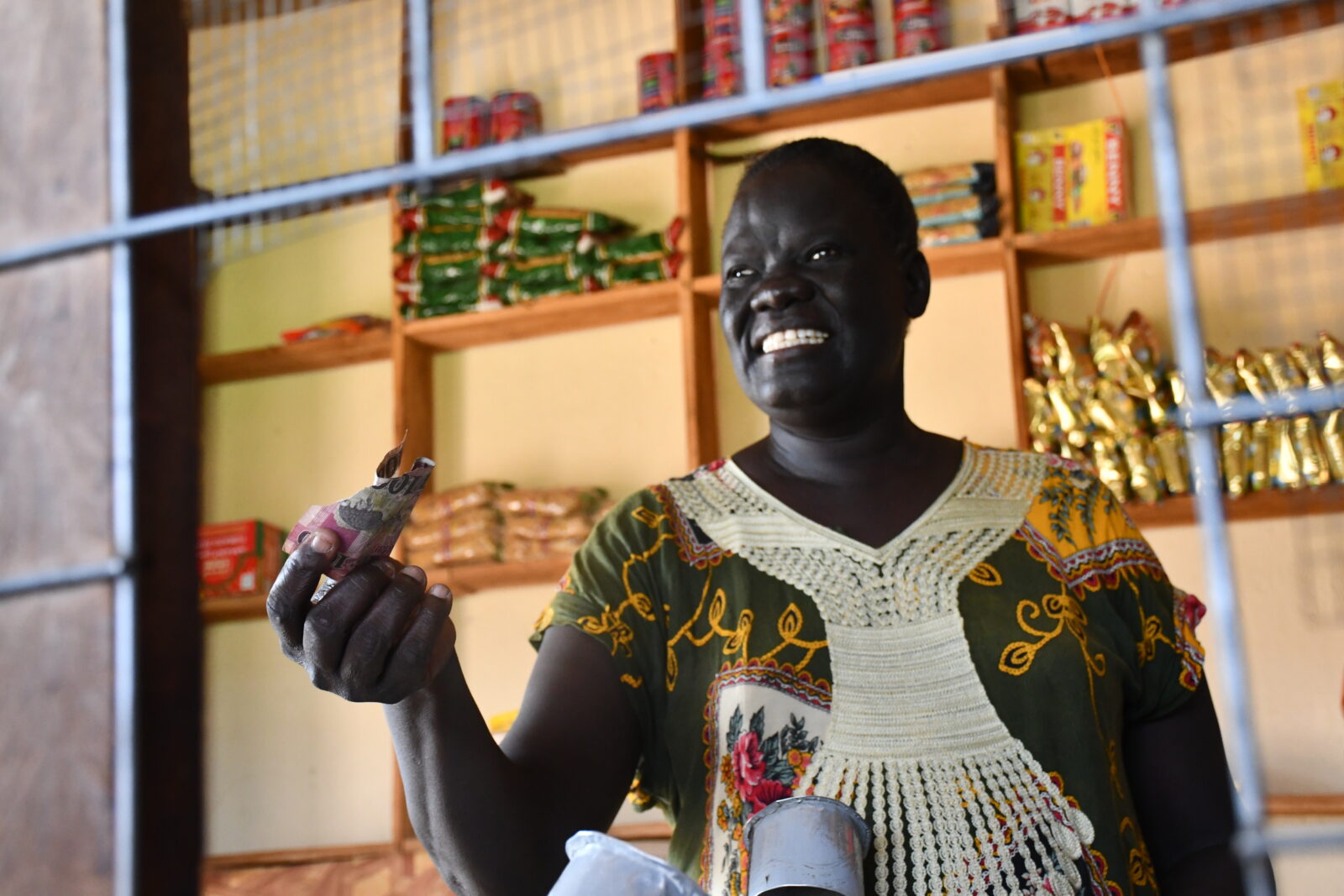
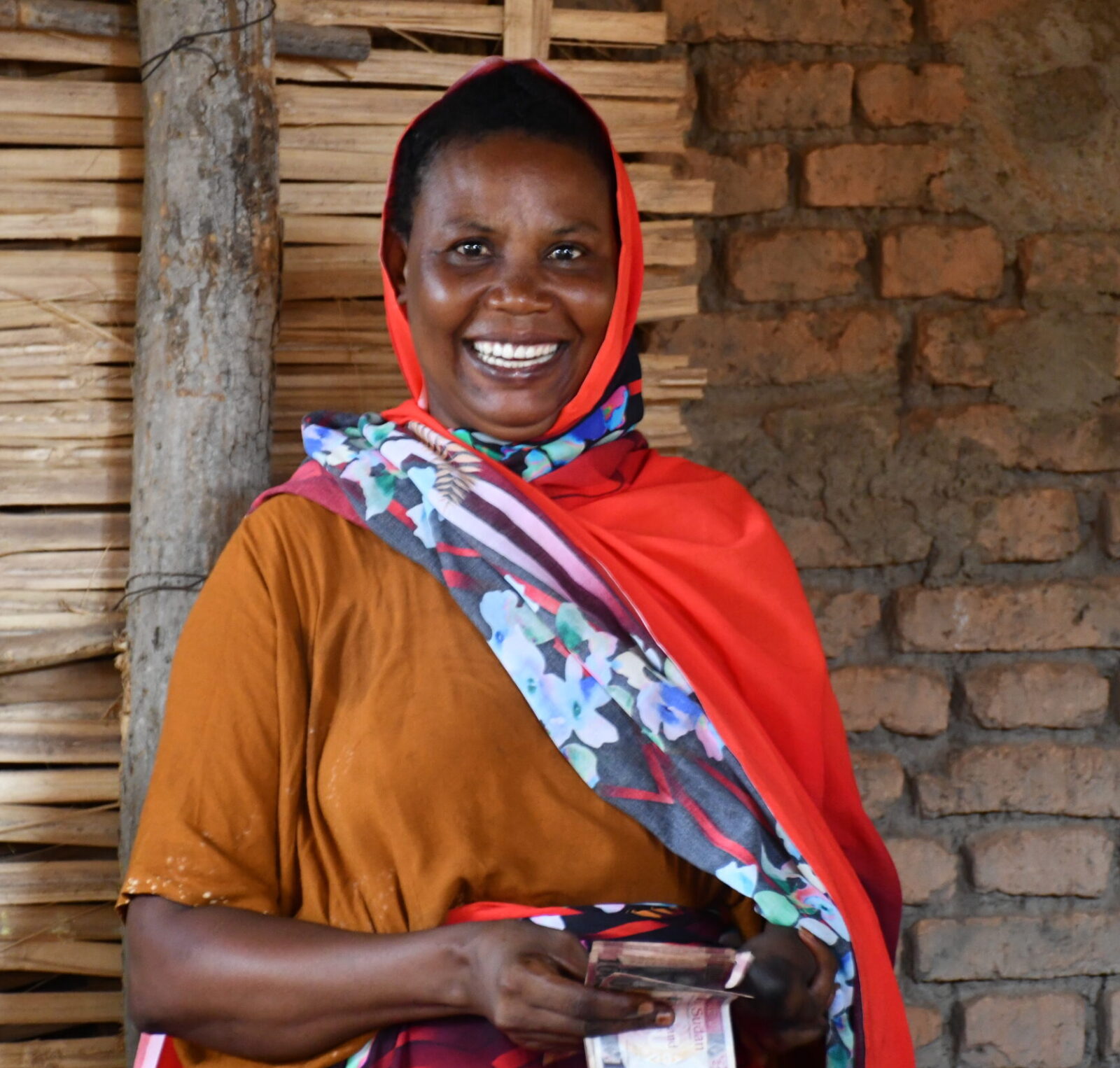
Fatuma (36) lost her husband in 2016 during the conflict in South Sudan. She started a small tea shop to pay her five children’s school fees. But people often ignored her shop and got their tea somewhere else simply because Fatuma’s hand has been amputated.
Fatuma: ‘I became discouraged because fewer and fewer customers were coming. But that changed when I joined a training on Village Savings and Loan Associations (VSLA). Together with other persons with disabilities and parents of children with disabilities, I learnt skills in entrepreneurship, customer contact, and financial management.’
Thanks to this guidance and start-up capital, Fatuma was able to buy cooking utensils and open a small restaurant. In addition, she started a savings group with other participants, in which they all contribute money and take turns receiving a larger amount. This helps their businesses grow and also strengthens mutual support within the community. Her business is doing well now, which means her five children can go to school and she can provide for all their daily needs. Fatuma: ‘Even if the project stops, we will continue to grow thanks to the knowledge we now have. I would like to expand and start selling food at the market so that I can also contribute to food security in my country.’
We are Able! in the Netherlands
In the Netherlands, SeeYou, in collaboration with the Dutch Coalition on Disability and Development (DCDD), advocated for an inclusive development policy, which led to the adoption of a motion and the submission of parliamentary questions.
Future for young persons with disabilities
Rwanda
Throughout this three-year project, SeeYou, together with UPHLS and RNUD, focuses on equality, inclusion, respect, and a better future for young persons with disabilities in Rwanda.
- After two years, we see progress in access to reproductive healthcare for women and girls with disabilities. Last year, 60 volunteers were trained, who subsequently provided information to 368 young people – 357 of whom were girls – with disabilities on family planning, menstruation, pregnancy, and gender-related violence. This knowledge increases their independence, control over their bodies and gender equality.
- RNUD organised a dialogue on access to reproductive healthcare for deaf girls and young women. This resulted in a policy memorandum and commitments from ministries and the healthcare sector.
- 24 healthcare workers from eight health centres underwent training on recognising various disabilities, communicating with deaf patients, and using inclusive materials, such as sign language posters.
- 237 young people have completed vocational training, increasing their chances of employment and income. In 16 Youth Business Groups, they receive support to start their own businesses.
- 25 vocational schools and entrepreneurs offered young people an internship. For example, in a furniture workshop, a bakery, and a car repair shop. They have also agreed to continue training young persons with disabilities after the project ends.
As a result of the Shift of Power – equality between organisations in development cooperation – decision-making is increasingly shifting towards our implementation partners. Strengthening these advocacy groups is one of the key goals of this project. Last year, the position of chair was transferred to UPHLS, and next year, RNUD will become the chair.

2025 8. SeeYou in The Netherlands

8
SeeYou in
The Netherlands
4545
individual donors
68
companies
57
funds and foundations
121
churches
20
SeeYou Grow Network Partnership
Towards sustainable fundraising
57 funds and foundations supported our work, contributing a total of €1,528,075. Our fundraising from funds, foundations, and major donors was marked by increasing competition, growing sector complexity, and efforts to attract new funding. We paid close attention to building new relationships and deepening existing bonds. The fundraising for the Eye Health programme went well. We realised that we need to look for new networks to fund our SeeYou Learns programme.
- Structural progress meetings and transparent reporting have strengthened collaborations, and several funds have expanded their support.
- Programmatic and non-labelled fundraising contribute to greater financial flexibility and continuity.
- Looking ahead to 2026 and future funding challenges, we have started a more targeted approach to raising major donations. This strategic preparation forms the basis for sustainable fundraising in the coming years.
What does a satisfaction survey among funds reveal?
Funds appreciate the transparency of our reporting, our commitment, our expertise, and the impact we achieve. We look to the future with confidence because many of the funds are open to continuing or expanding the collaboration.
‘The sooner children with a disability receive the right care and education, the greater their chance of a full place in society. With the return on the assets of the Feitz-Dreesmann couple, we are happy to invest in future prospects through projects such as Participation from the Start.’
Ann Gummels, Programme Manager of the Ineke Feitz Stichting
New in 2025: The SeeYou Grow Network
In April 2025, the SeeYou Grow Network was launched to bring together entrepreneurs from among our supporters. We started with 10 network partners. That number had already doubled to 20 in 2025, and we hope to reach 40 this year. In total, 68 companies supported our work with a combined contribution of €172,461 – almost a doubling of the total in 2024.
- SeeYou Grow Event
During the SeeYou Grow Event on 15 April, our ambassador Jurjen van Houwelingen inspired entrepreneurs, funds, and foundations with his life story of resilience.
- Impact Dinner
In November 2025, we organised the Impact Dinner at the Residence Rhenen – a partner of the SeeYou Grow Network. Gabriël Anthonio spoke during the dinner, and entrepreneurs generously offered auction items. We received many positive reactions about the event.
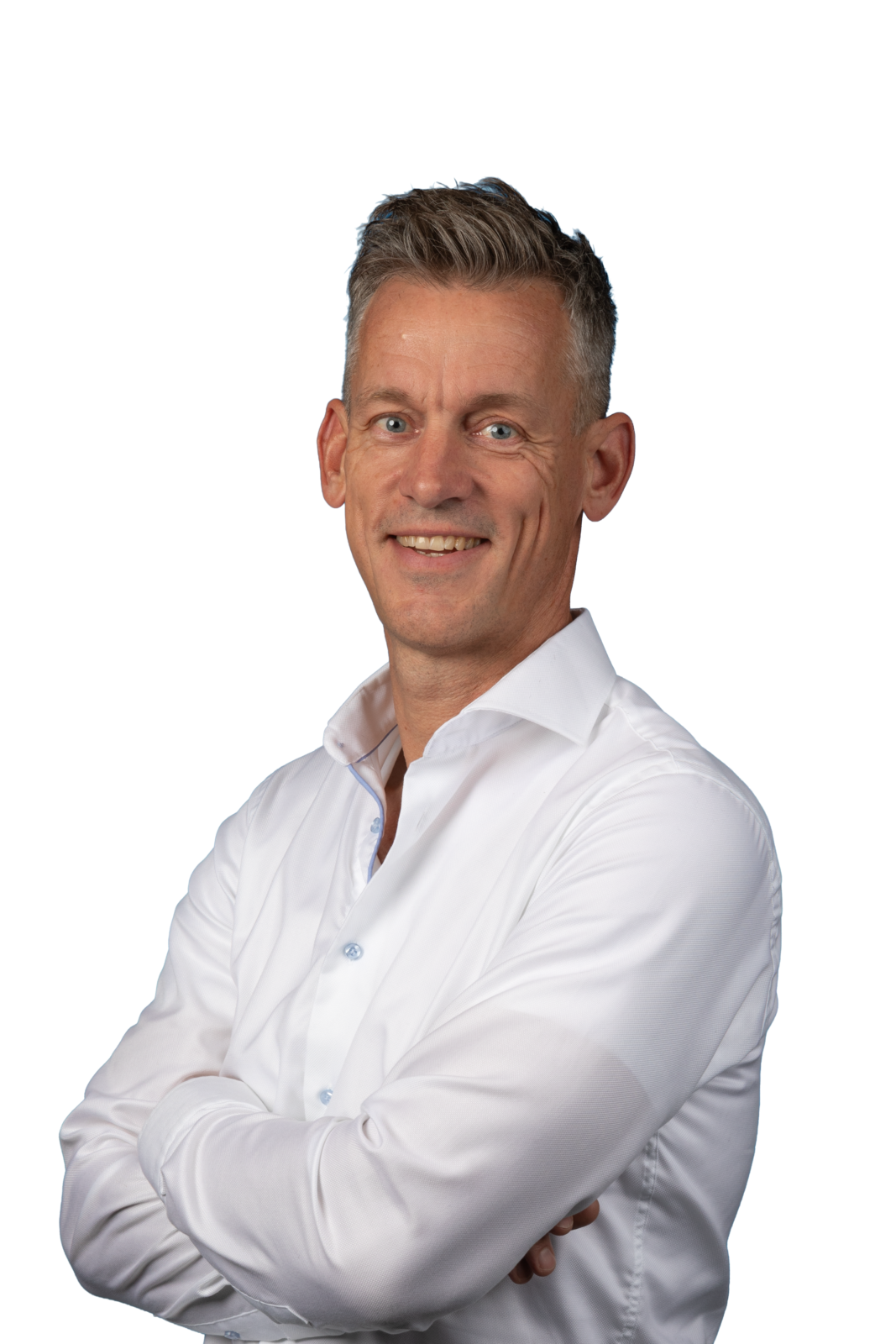

Entrepreneur Jaap Lucas:
‘In the profusion of charities, SeeYou takes a very practical approach.’
‘The SeeYou Grow Network is an opportunity to connect with people and be inspired by speakers and the stories shared. And it is a great opportunity to meet other entrepreneurs during various activities, such as the Impact Dinner. A beautiful setting, with a good dinner, an inspiring speaker, and an auction, including a dinner voucher from the wedding location of my wife and I: naturally, I had to bid on that!
As an entrepreneur, I find it difficult to make time for voluntary work, for example, but with financial support, I can still make a concrete contribution to addressing global needs. Visual impairment has major consequences in other countries, including exclusion from society. While a relatively small intervention can make such a difference. In the profusion of charities, I appreciate the practical approach SeeYou takes.
If you’re still unsure whether to give a donation, but think you have sufficient wealth to share? Then you could just give it a try. It is not a very big decision, unlike getting married or buying a house. Why not begin with giving just one good gift first? That alone would already make SeeYou very happy!’
Jaap Lucas, owner IT Selector
Featured campaigns
- Goal: 50,000 eye treatments
We set a very concrete, ambitious goal to raise funds for 50,000 eye treatments through our SeeYou Eye Health projects. Among other things, a Vacation Bible Week in Wapenveld and the auction during the Impact Dinner contributed to the impressive total of 37,054 eye treatments funded. We will continue with this campaign in 2026. - Campaign for inclusive education
Our ambassador, Berdine Zwanepol, was the face of the ‘Every Child to School’ campaign, which we used to raise awareness about inclusive education for children with disabilities in Indonesia.
- Be courageous, don’t look away
In the first quarter, we faced the discontinuation of USAID funds and budget cuts in the Netherlands. In response to that, we launched an additional campaign: ‘BE COURAGEOUS, DON’T LOOK AWAY’. With this, we wanted to speak out strongly against these cuts and strengthen support for development cooperation in the Netherlands.
Supporters survey
At the end of the year, we conducted a short survey among our supporters with questions about their involvement and support for SeeYou. Among other things, this revealed that many of them greatly appreciate the personal stories of people in our project countries. One beautiful response was: ‘I support SeeYou because they make a difference where other organisations cannot in this area.’
2025 9. Working together

9
Working together
Equal partnership
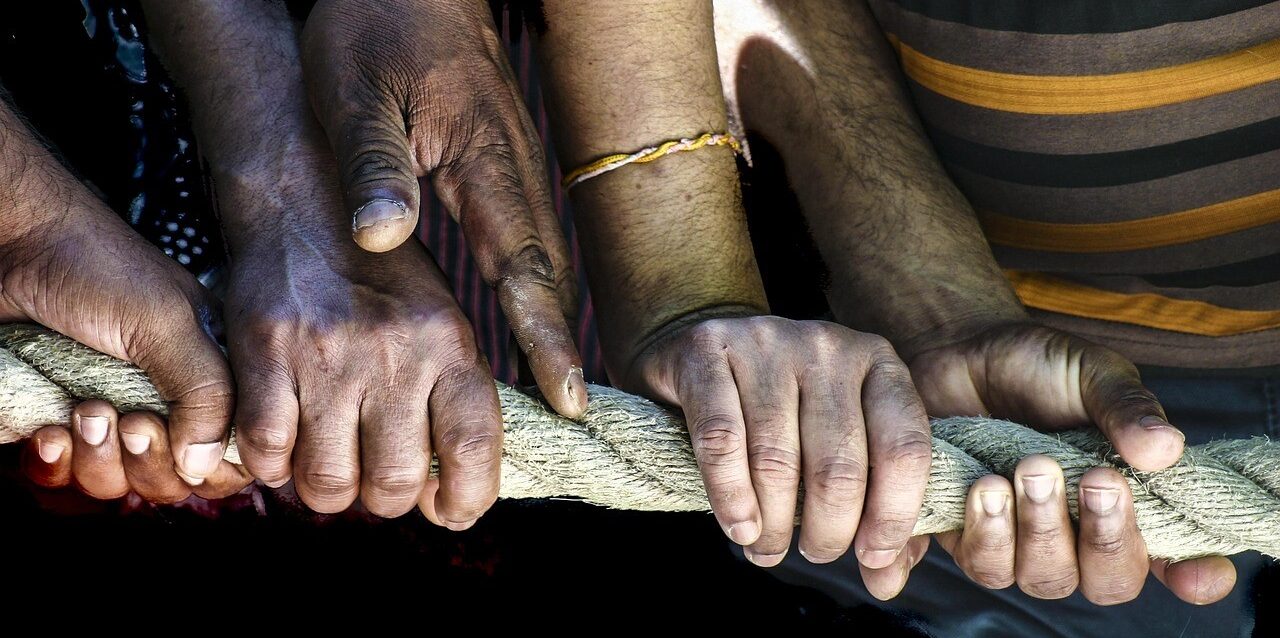
In all our projects, we work in partnership with local organisations. Through equality, appreciation for each other’s work, and the sharing of knowledge and expertise, we can create a greater impact together. Our partners know the situation, community, and culture, and possess the necessary specific expertise regarding (eye) care, education, or employment. Depending on the project, we also work with local schools, churches, or businesses.
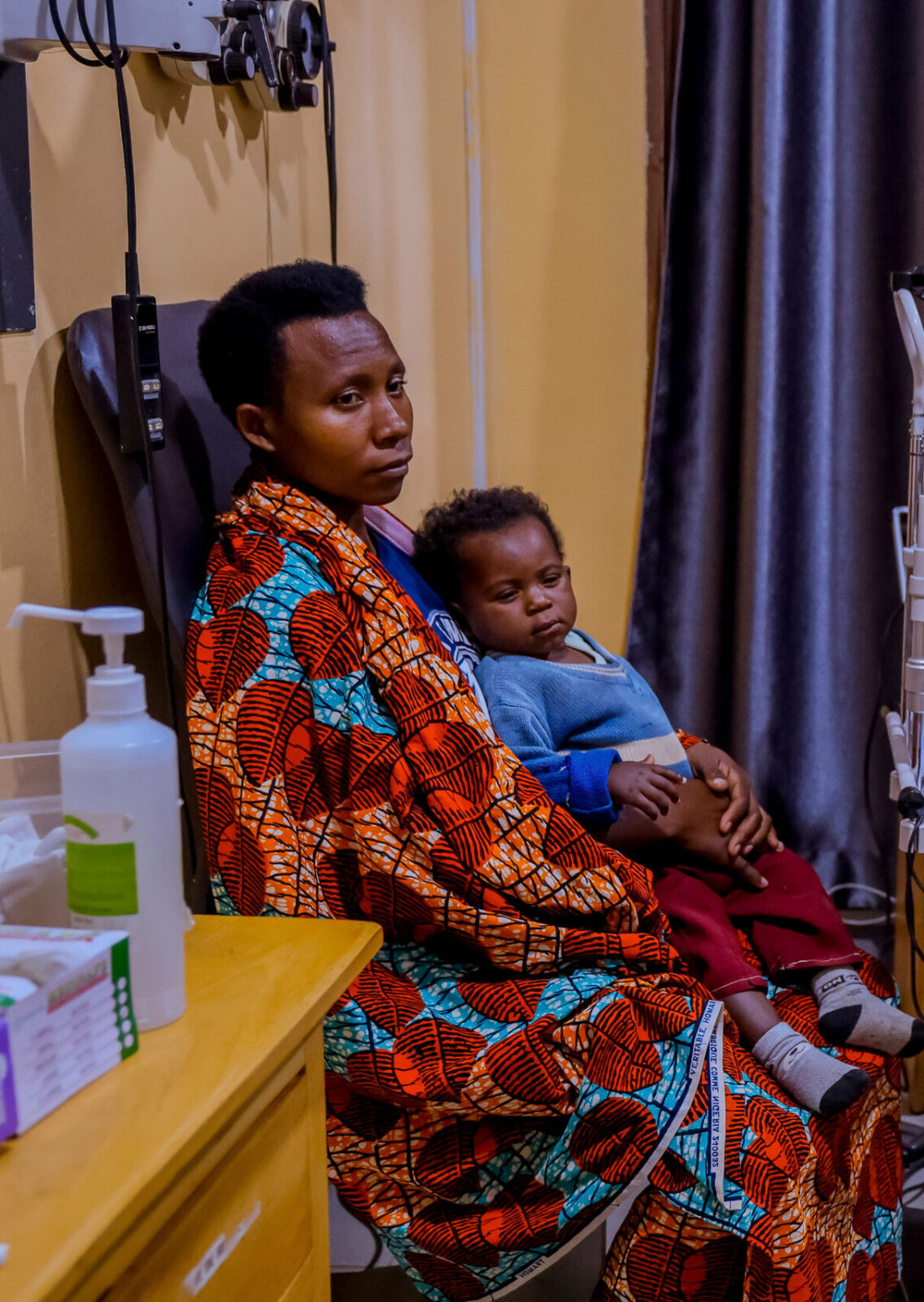

The cooperation between partner organisations changed everything for Jean Paul’s family
‘Why us?’ That used to be the question Jean Paul’s family asked itself for years. Eight family members, including Jean Paul, suffered from the eye condition glaucoma, a condition in which elevated eye pressure can lead to complete blindness. Jean Paul was born with this, but never had the means to seek treatment, causing him to slowly lose his sight. When he became a father, his first child turned out to have the same condition, as did his second and third child. Eventually, all seven children inherited their father’s eye condition. For years, his wife, Anne Marie, single-handedly cared for eight family members with a severe visual impairment.
UNABU came into contact with the family during an eye screening within the community and discussed the case with one of the doctors at Kabgayi Eye Hospital. This is why 15 July 2025 became an unforgettable day for Jean Paul’s family. Thanks to a collaboration between UNABU, KEU, and See You, the entire family received free, specialised eye care. Several family members underwent surgery and the decisions was taken to closely monitor the youngest children.
‘For years, I had only one prayer: that I would one day be able to see the world again’, said Jean Paul. His wife described the day and the outcome as a miracle!
Giving a greater say to organisations representing persons with disabilities
As SeeYou, we advocate for stronger collaboration and an equal partnership with organisations representing persons with disabilities. As part of a collaboration with the Leprosy Mission, a research volunteer investigated this. One of the conclusions was the importance of allocating resources for the involvement and capacity development of these advocacy groups. Then they can gain a greater say and responsibility in a project from its development through to its evaluation.
Shift of Power
As SeeYou, we believe in the Shift of Power principle. ‘This approach allows local partners to gain more and more influence and take on greater responsibility for implementing projects, whereas our supporting role is that of facilitator. Experience shows that this shift is a gradual process, which we regularly evaluate. To guide this process, we conduct a ‘Shift the Power’ assessment with each partner.
Partner satisfaction
During regular consultations and partner visits, we discuss not only the progress of projects with our partners, but also our mutual cooperation. Partners feel they are treated with respect and that a strong bond of trust exists. They appreciate the positive and open communication with SeeYou. We conduct a partner satisfaction survey every two years; we will do this again in 2026.
Cooperation with Light for the World Belgium
In 2025, we renewed our cooperation with Light for the World Belgium. After previous successful projects, we will be joining forces again. This time, as part of our expansion to Tanzania, where Light for the World Belgium has been performing valuable work for some time. With this, we are taking an important step in making quality eye care accessible to children in Tanzania.
Adopted motion for inclusive development policy
Together with the Dutch Coalition on Disability and Development (DCDD), we advocate for inclusive development policies from the Dutch government. For example, in the run-up to the Dutch general elections, we called upon parties in their political manifestos to devote attention to persons with disabilities in developing countries. At the initiative of DCDD, members of parliament Don Ceder (of the Christian party ChristenUnie) and Mpanzu Bamenga (of the social-liberal party D66) submitted a motion on inclusion in development cooperation policies. The motion was adopted! This led to discussions with the Ministry of Foreign Affairs, during which a report was presented that examined the inclusivity of Dutch development cooperation policies. We will continue these efforts in 2026.
Working together in networks
Through various networks and sector associations, we share our knowledge and continue to learn about inclusion, eye care, business operations, and fundraising. Through our membership in these networks, we are even better informed about national and international inclusion developments.
Partos
A sector association that brings together more than 100 Dutch organisations for development cooperation and humanitarian relief.
Prisma
An association that focuses on the role of Christian organisations in international development cooperation.
.
Dutch Coalition on Disability and Development (DCDD)
The most important Dutch network for inclusion and representing the interests of persons with a disability in developing countries. Our Director Jolanda Omvlee is a member of the DCDD board.
EU-Cord
European network that focuses on collaboration and policy influencing in international collaboration. Within this network, there is specific attention to lobbying and advocacy, as well as institutional fundraising.
Within this network, our colleague Micha Schutten last year called for organisations representing people with disabilities to be treated as full partners (externe link, opent in nieuw tabblad).
International Disability and Development Consortium (ICDD)
International platform for stakeholders in the area of disability and inclusion.

From banking to the charity sector
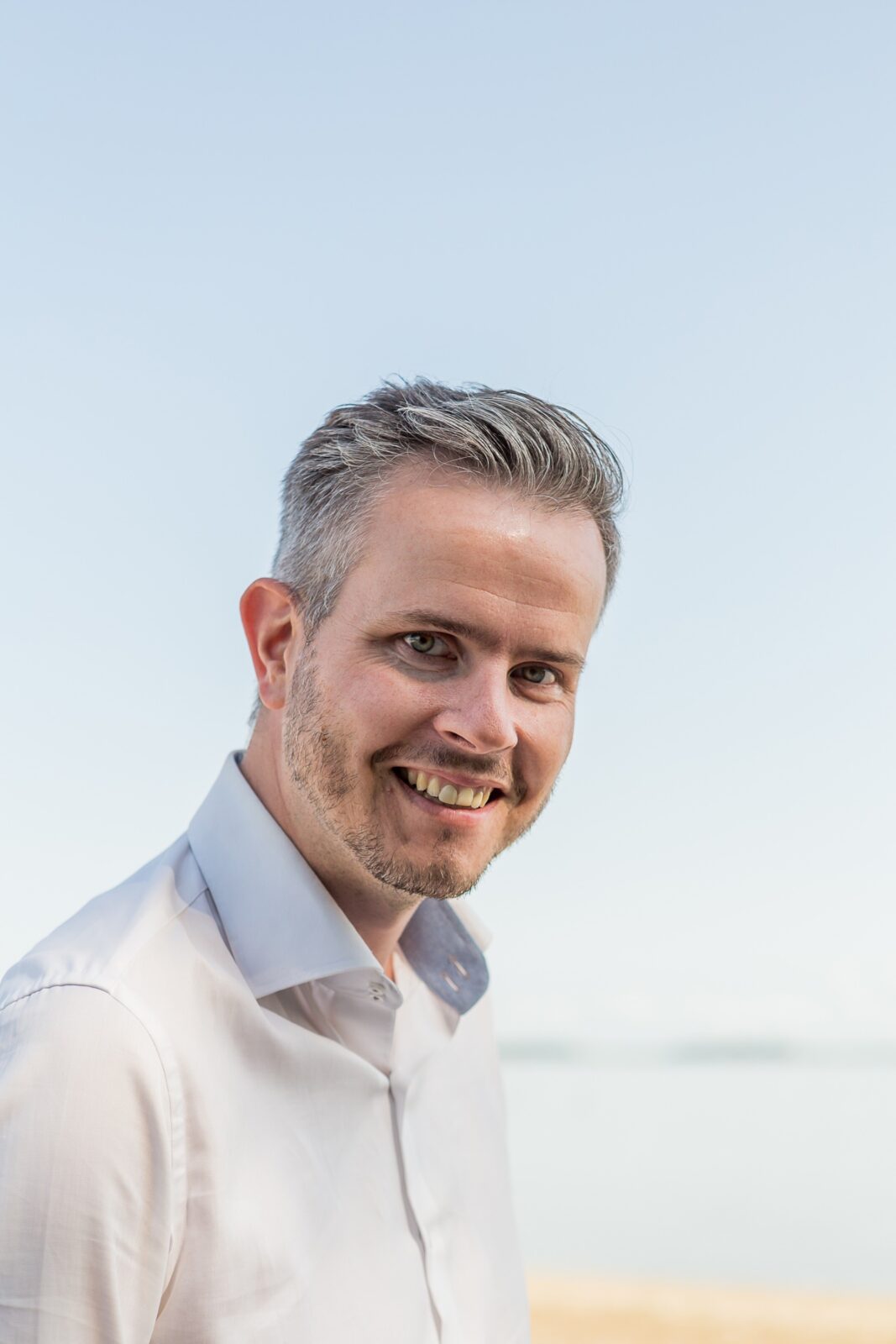
Last year, relationship manager Wijnand van den Bosch set up the SeeYou Grow Network, a group of committed entrepreneurs with a warm heart for SeeYou. Wijnand previously worked in the banking sector for 15 years. A completely different world? Or are there more similarities than you might expect? Wijnand tells us about his career switch and the SeeYou Grow Network.
‘After I became a Christian, target-driven work didn’t suit me so well anymore. I had changed and, as a result, also sought a different purpose in my life. On the one hand, the difference between the banking sector and the charity sector is quite significant, and where that is the case, the charity world suits me better. At the same time, I am now sitting at the table with the same wealthy target group. However, on behalf of the bank, the question was ‘How can you grow your wealth?’ and now it is ‘How can you use your wealth to do good?’ The beauty of this approach is that it shows me much more of the heart of entrepreneurs.
In April 2025, we launched the SeeYou Grow Network to bring together entrepreneurs from among our supporters. Network partners meet at our events, support specific projects close to their hearts, and expand their business networks at the same time. Within the non-profit sector, we are becoming increasingly dependent on companies and organisations, as governments withdraw more. I hope that the SeeYou Grow Network will grow and flourish, that entrepreneurs will inspire each other, and that it will challenge them to take on a bit of responsibility.’
2025 10. Our organisation


10
Our organisation
Organisation structure
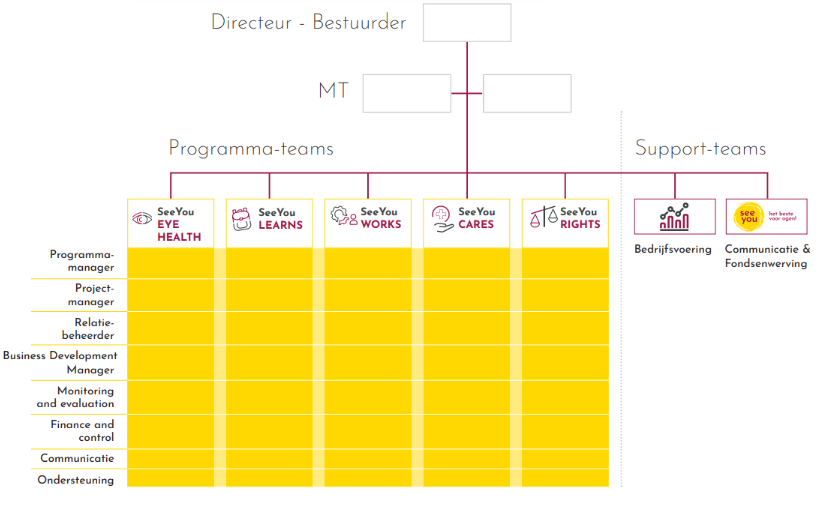
The guiding principles of our organisation are: short lines of communication, a clear division of roles, devolved responsibilities, and collaboration based on expertise. We achieve this with:
Multidisciplinary teams
We work within multidisciplinary, self-organising teams, aligned with our four core programmes. This approach works well and integrated decisions are being made because colleagues with substantive programme expertise work more closely together with colleagues in fundraising, ICT and financial control.
Light management layer
We strive to realise an organisational structure as light as possible and appropriate to SeeYou’s size. We have a small management team, consisting of the Executive Director and Head of Programmes.

Our team
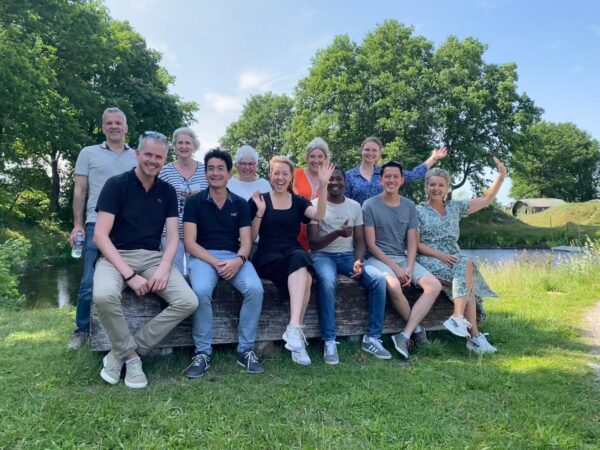
In 2025, we bid a warm farewell to two colleagues who had been associated with SeeYou for a long time. One of them retired, and the other colleague stopped due to health reasons. By the end of 2025, our team consisted of 10.85 FTEs, with 13 salaried employees and one self-employed professional. Absence due to illness remained approximately the same at 8.79% – consisting almost entirely of long-term absence.
Team day and employee satisfaction
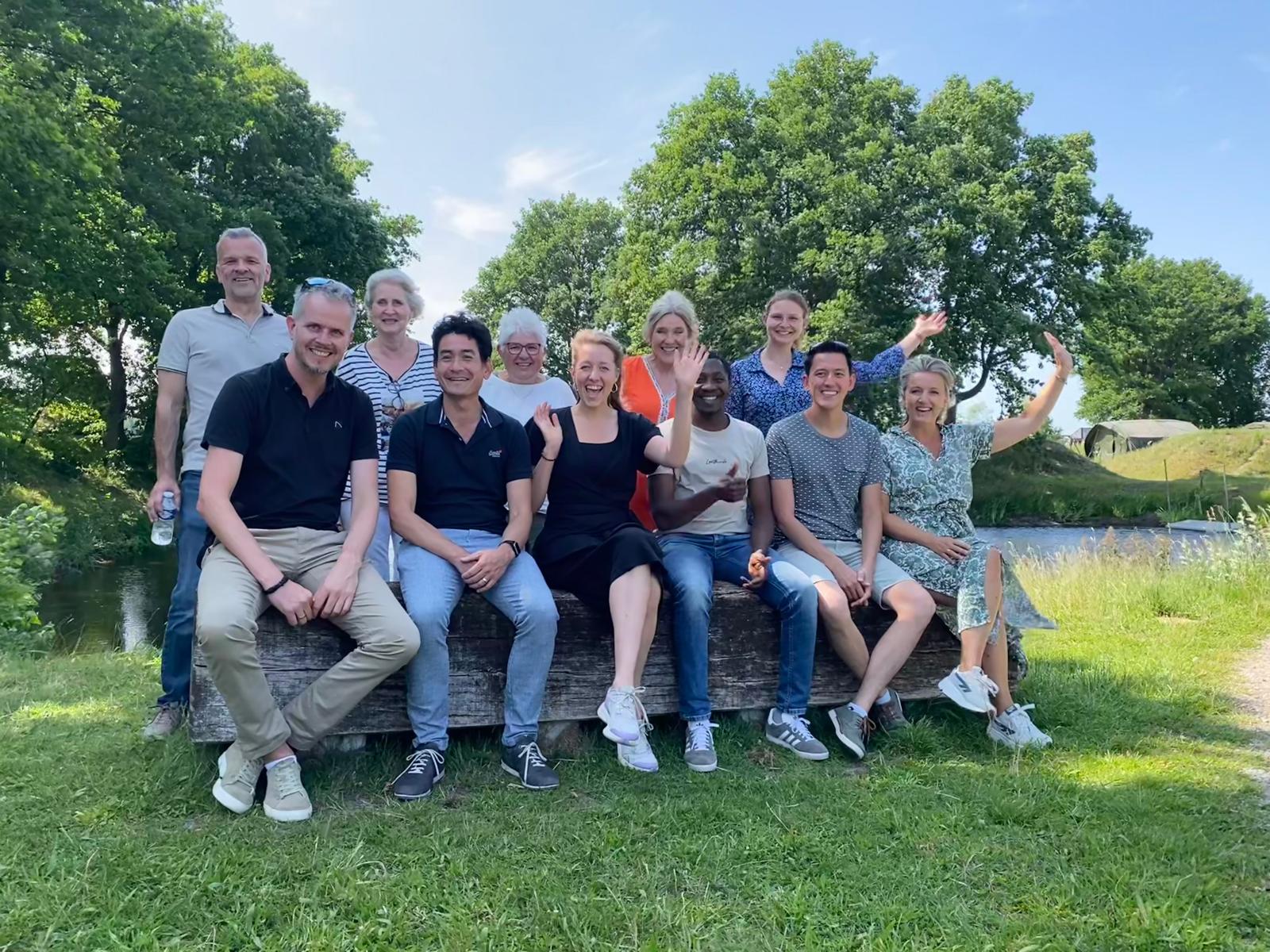
During a fun team day near our office, we enjoyed a guided tour, an archery workshop, and a shared meal.
Our employee representatives met with the Director in 2025 to discuss, among other things, the employee satisfaction survey, the annual plan, and the budget. The employee satisfaction survey revealed that the entire team has a good relationship with colleagues and supervisors, a positive view of management, considers their work rewarding, and is treated with respect.
Quality
Our quality management system is structured according to the principles of ISO 9001 and the sector-specific Partos 9001.
- In November 2025, we had an ISO/Partos audit. We scored well across the board, and the only point of attention we received was to better embed environmental and sustainability aspects in our policy.
- We have rewritten our quality manual because we want to work professionally. Various separate procedures have been merged into a single handbook with process owners.
Three quality marks
Thanks to our quality marks and certifications, our donors can be certain that we contribute to a better world, use every euro we receive carefully, provide accountability, and undergo an independent audit.
Recognised as a charity by the Central Office for Fundraising(Dutch abbreviation: CBF)
As a CBF Recognised Charity, we meet the strict quality requirements that are audited by the regulatory authority, CBF. This quality mark was extended for a period of three years in 2025
ANBI
We have been designated a charitable organisation (Dutch: ANBI) by the Dutch Tax and Customs Administration, which means that donations to SeeYou are tax-deductible.
ISO 9001 and Partos 9001
We are ISO 9001 and Partos 9001 certified. This certification covers internal and external processes, which are regularly tested and adjusted.
Complaints
We handle the feedback we receive with care because it helps us to learn and to improve the quality of our work. Complaints regarding the behaviour of SeeYou employees, partners, and project execution can be submitted via the email address: complaints@seeyoufoundation.nl
In 2025, we received a complaint regarding possible misconduct that took place at a collaboration partner. The partner in question engaged an external investigator, who found no evidence of wilful misconduct. We have been closely involved in the process, and the partner will follow up on recommendations from the research report to strengthen policy and the work environment.
In addition, we received a complaint regarding the form of address in our communication. We have agreed to explicitly take this into account in future communication with this donor.
Integrity
Integrity is high on our agenda. We know – and countless studies show this as well – that persons with a disability face a considerably higher risk of being abused. Safety, an open learning culture and a strong integrity policy are vital for preventing such abuse. Because we work directly with local partner organisations in Africa and Asia, we also make sure that our partners have a strong integrity policy in place.
Revised Integrity Policy
In 2025, we drafted a new version of our integrity policy. The previous version dated from 2022 and contained obsolete information. The main changes:
Overview of reporting points
This overview has been revised and clarified: it is clear where to go for each type of complaint. And there is always an alternative reporting point should the complaint relate to the primary contact person.
Alignment with external guidelines
We have aligned our policy with the most recent, relevant codes of conduct and guidelines, including those of the CBF, ISO, and Partos.
Integrity during business trips
With every contract with implementation partners, a document is included by default that outlines SeeYou’s key commitments and explains the reporting system. We have developed new Terms of Reference (ToR) for business trips that, by default, include safeguarding and integrity.
Due diligence
During a due diligence review of a partner, our integrity officer assesses whether the integrity documents meet our quality requirements.
Furthermore, our integrity policy (externe link) states what ethical conduct we expect from ourselves and our partners. And the policy includes an Integrity Statement, Code of Conduct, Prevention Policy, Reporting Code, and references to underlying regulations such as the transparency & anti-corruption policy, confidential counsellors scheme, whistleblower scheme, and a complaints procedure.
Acting with integrity internally
We also want our employees to experience a pleasant working atmosphere and a safe working environment. We therefore have measures for prevention, adequate support and aftercare, including internal and external confidential counsellors. The annual report of the external confidential counsellor shows that no reports were received in 2025. Within our organisation, the integrity officer and the Executive Director are primarily responsible for the theme of integrity.
As part of our preventive measures, we regularly discuss the importance of acting with integrity and the concrete moral dilemmas this entails. Since 2025, we have been doing this annually through Moral Deliberation, a structured method for arriving together at a morally sound judgment on ethical questions.
Integrity at our partners
Partner organisations must demonstrate that they have an active integrity policy and sign the integrity principles stated in contracts. During our contacts with partner organisations and working visits, the topic of integrity is always on the agenda.
In 2025, our integrity officer organised an integrity training for all partners in Rwanda together with UNABU. Partner PRY in Indonesia also took part in an integrity training. These training sessions were well received and strengthened mutual cooperation and awareness.
One of our partners experienced an email hack last year, during which altered bank details were shared. Fortunately, vigilance prevented a payment from being transferred to a fraudulent account. In response to this, several procedures have been tightened, including confirming changes to bank details via a video call.
Code of conduct
Our core values are the basis of all our actions: every person is valuable, there is room for everyone, love your neighbour, and justice. We also endorse the Partos Code of Conduct (externe link), which includes guidelines on cooperation with civil society organisations in project countries, on setting up a professional organisation, and on communication and fundraising.
We fully realise that we always work with the financial resources entrusted to us by others, such as donors, funds, and foundations. Therefore, to minimise the risk of abuse of these resources, we follow the guidelines as set out in our Transparency & Anti-corruption Policy. (externe link)
Corporate Social Responsibility (CSR)
Our CSR policy statement is based on three principles:
Working fairly and honestly
The previous sections on Quality and Integrity describe how we shape this.
Respect for our stakeholders, our work and our organisation
In addition to regular satisfaction surveys, various stakeholders – such as ambassadors, donors, funds and foundations, the founders’ family, and strategic partners in our project countries and in the Netherlands – are consulted on strategic decisions.
Respect for the environment and society
We want to use natural resources sparingly and try to limit our carbon footprint wherever possible. For example, we always make a conscious decision about whether a business trip is necessary; our office has been fitted with solar panels; we partly work from home; we opt for sustainable coffee; and our office is closed two days a week during the winter months.
Risk management
Our work often involves risks and uncertainties. Through our risk management, we prevent risks from becoming reality and limit their potential impact. We implement structured risk management, including a three-monthly risk analysis by the management team, and a sound policy on project expenditure, reporting, monitoring, and integrity. We foresee five important risks in the coming years.
1. Loss of income due to less government funding
Probability: high
Potential impact: high
There are changes in the political landscape, government funding has been cut in both the Netherlands and the United States, and funds for development cooperation have been reduced as well. These changes result in lower revenues. And because more NGOs are seeking alternative sources of funding, the chances of success for fundraising applications to funds and foundations, and institutional funds are decreasing.
Our measures:
- Develop new innovative strategies
- Only award expenditure if the income is guaranteed
- Spread risk by expanding our programme portfolio and spreading the use of legacies over several years
- Closely monitor income development and make strategic choices where necessary
- Adopt an active approach to major funds and a targeted corporate approach
2. (Political) unrest in project countries
Probability: high
Potential impact: medium
We work in various countries where the political environment is fragile, and conflicts can flare up at any time. For example, a civil war is taking place in Sudan and at the end of 2024, a conflict broke out in Congo and the border area with Rwanda. Persons with disabilities are hit particularly hard in situations of war and conflict, as it becomes even more difficult for them to gain access to care, education, and work. Additionally, these situations can affect the stability of our partners and the projects.
Our measures:
- We closely monitor the situations in conflict zones where our partners are active. And each month, we discuss the stability of the projects in our meeting with our partners;
- We continue to draw attention to the rights of persons with disabilities in those situations as well, and call on governments to make (emergency) aid inclusive for persons with disabilities;
- We deploy extra emergency relief campaigns where necessary.
nodig.
3. Integrity violations
Probability: medium
Potential impact: high
In a period in which (sexually) undesirable behaviour makes the headlines, we are aware that this is a potential risk in all companies and organisations. And that our target group is particularly vulnerable to this. Possible violations of integrity not only result in a considerable loss of reputation but, above all, cause lasting damage to a person’s life.
Our measures:
- Strong integrity policy
- Annual Moral Deliberation
- Ongoing internal discussions about integrity within our organisation and partner organisations
4. Fraud and cybersecurity
Probability: medium
Potential impact: high
Data breaches, phishing, ransomware, or email hacks can lead to fraud, unauthorised access to systems, or data loss, thereby resulting in reputational damage and a loss of trust from donors or partners.
Our measures:
- Tighten procedures and controls
- Improvement cycle completed annually
- Internal processes aimed at preventing fraud, which are controlled both internally and externally
5. Limited team capacity
Probability: low
Potential impact: high
With the smaller size of our organisation, we try to achieve the maximum with the minimum. However, this does mean that the (temporary) absence of a team member is immediately felt.
Our measures:
- Organise the work as effectively as possible in self-organising, multidisciplinary teams
- Pay attention to mental health, prevention of absenteeism, and good guidance for colleagues
- Remain focused on ensuring an attractive work environment as well as job satisfaction
2025 11. Board and supervision

11
Board and supervision
Our Supervisory Board
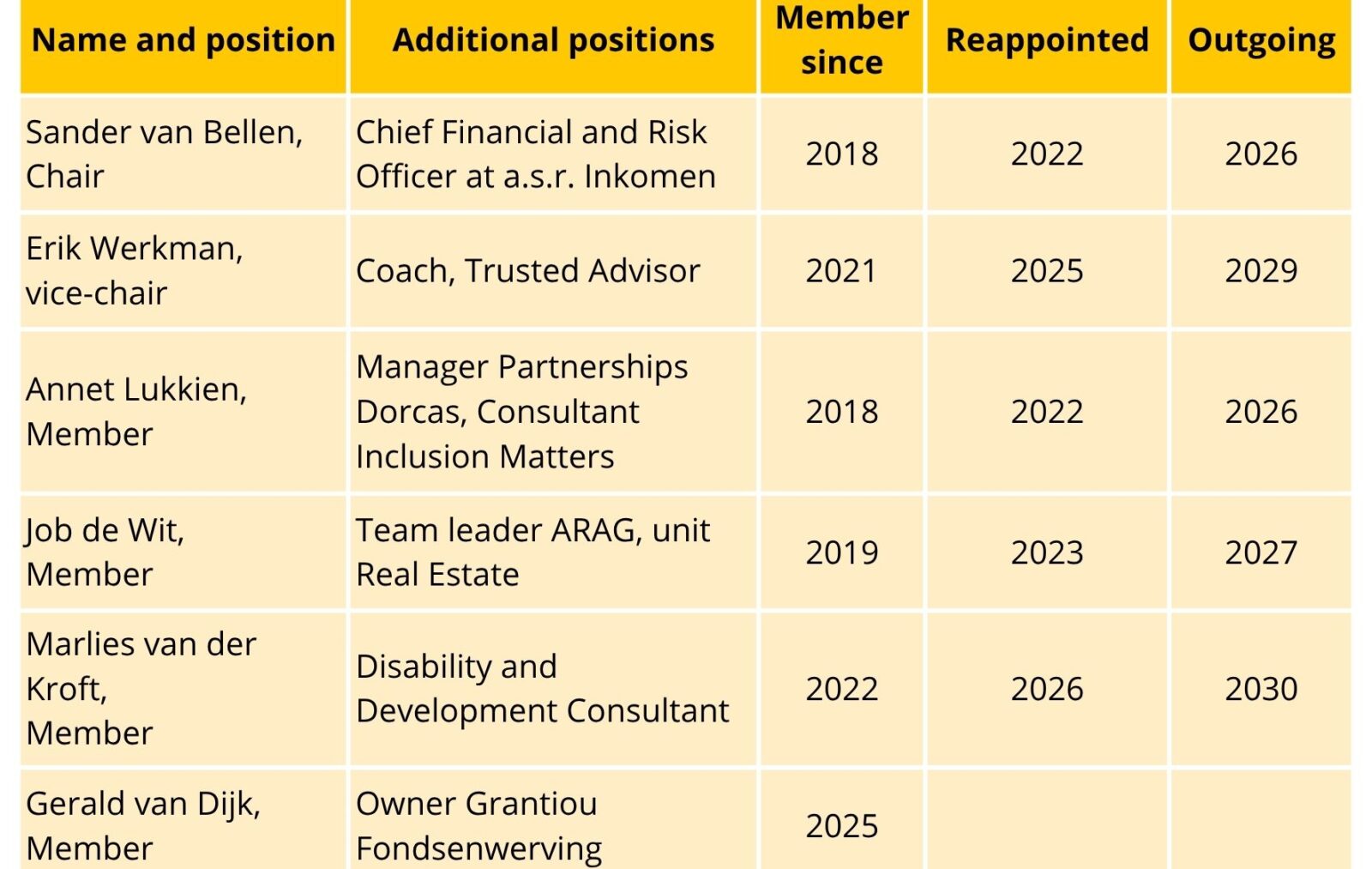
The Supervisory Board safeguards our mission and identity and oversees the Managing Director, policies, and the plans of our organisation. Gerald van Dijk joined the Supervisory Board in 2025. He contributes years of experience in organisational development within the non-profit sector and would like to put his expertise to good use for SeeYou, with a specific focus on fundraising.
‘I have a strong sense of justice, and inequality affects me deeply. Especially when this can be resolved or reduced with a relatively simple intervention. I believe it is important that everyone has equal opportunities in the world, which is why I would like to put my knowledge and experience to good use for SeeYou.’
Gerald van Dijk, Supervisory Board member since 2025
The roles and responsibilities within the Supervisory Board are laid down in the Articles of Association and elaborated in the Regulations for the Executive Board and the Supervisory Board (externe link, opent in nieuw tabblad). Supervisory Board members do not receive financial compensation for their work, but they may claim reimbursement for expenses incurred in performing their duties as Supervisory Board members. In 2025, meeting expenses totalled €724, and travel allowances totalled €612. Good governance and supervision are part of the Erkenningsregeling Goede Doelen (Charitable Organisations Recognition Scheme) and are assessed to qualify for the CBF quality mark (externe link, opent in nieuw tabblad).
SeeYou’s Supervisory Board

Executive Director’s salary
The Supervisory Board has determined the remuneration policy, the level of remuneration for the Director and the size of other remuneration components. This is updated each year. For this, we follow the Salary Regulations for Directors of Charitable Organisations, as drawn up by the Dutch sector organisation Goede Doelen Nederland. Using these weighting criteria, the Supervisory Board has awarded our Director, Jolanda Omvlee-Tijhuis, a so-called baseline score for a management role (Dutch abbreviation: BSD) of 380 points.
Her annual income in 2025 amounted to €66,439, including a holiday allowance and an end-of-year bonus. Her pension contribution was €7,601. As a result, the annual income, taxable allowances and additions, and the employer’s pension contribution remained well within the maximum limit included in the Remuneration Scheme. In the annual accounts under ‘Explanation stated income and expenses’, the size and composition of the remuneration is explained in greater detail.
Additional positions of Executive Director Jolanda Omvlee-Tijhuis
- Owner Jolanda Omvlee-Tijhuis Executive Coach & Interim
- Owner and founder of Pilgrim Leaders
- Chair of the Supervisory Board of the Hannah group of schools in Bergentheim
- Board member of the Dutch Coalition on Disability and Development (DCDD)
Meetings and decision-making in 2025
The Supervisory Board met on five occasions in 2025. This involved four regular meetings and a supervision training by an external expert. A strategy session was also held that day to discuss the impact of our programmes and fundraising.
The Supervisory Board met to discuss, among other things, the 2024 annual report and financial statements, the 2025 annual plan and budget, the new multi-year strategy, our integrity policy, remuneration policy, and the employee satisfaction survey. The Audit Committee met three times to discuss, among other things, the annual accounts and the multi-year budget. The Programme Committee also met three times and discussed the partnership policy, monitoring and evaluation, and programmes in the 2025 annual plan.
Evaluation by the Supervisory Board of its own functioning
The Supervisory Board evaluates its own functioning annually. In 2025, the board members concluded that the division of roles between management and the Supervisory Board functions well. One point of attention identified was the need for more insight into the strategic choices regarding human rights and the monitoring and evaluation of the programmes, so that the board can properly fulfil its supervisory role.
2025 12. Finances

12
Finances
Financial results 2025
In 2025, we once again achieved positive results, both in terms of realising our objectives and financially. Our income was higher than budgeted, our target spending percentage rose, and the percentage of donations from private individuals increased. At the same time, declining government funding has brought challenges. Below, we explain the key developments in income, expenses, and expenditures. The complete annual accounts are presented in the following chapter.
Explanation of income, expenses and expenditure policy
In 2025, we had 3.3 million euros from donations available to spend directly on projects, programmes, and awareness/education about eye care and inclusion.
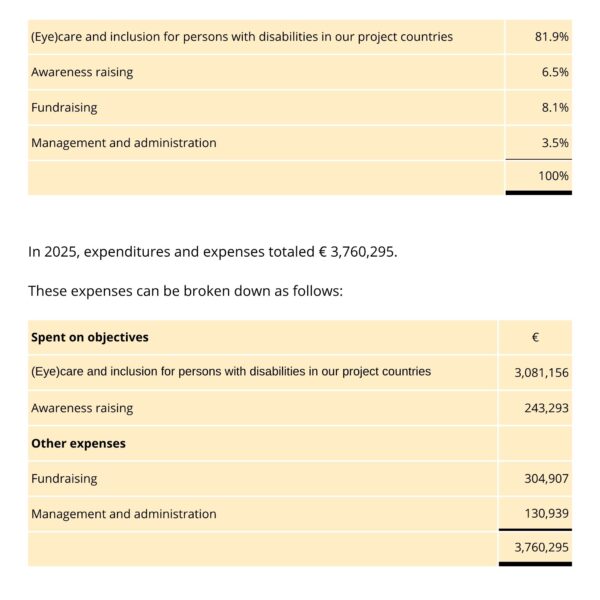
- Of the total expenditure, we spent 88.4% on our objective (compared to 87.2% in 2024). 81.9% was directed to our programmes and projects through local partners, and 6.5% was spent on education and awareness about eye care and inclusive development.
- A growing share of our income consists of programmatic contributions. These earmarked sources of income can be flexibly deployed within predefined programmes, such as SeeYou Eye Health and SeeYou Learns. This positive development contributes to an efficient allocation of resources and reduces reliance on project-specific financing, which is consistent with a sustainable financing strategy.
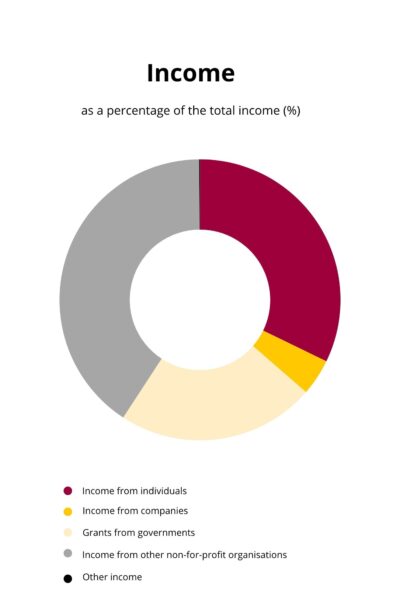
- Income from government funding decreased from 30% of the total income in 2024 to 22% in 2025. This is primarily due to the completion of the We Are Able! programme and the lack of new government contributions. As a result, the composition of the income has changed, and the relative importance of private fundraising has been increasing.
These developments emphasise the importance of diversifying sources of income. Therefore, our focus is on strengthening fundraising activities and developing new propositions for funds and foundations, companies, and individual donors.
Income
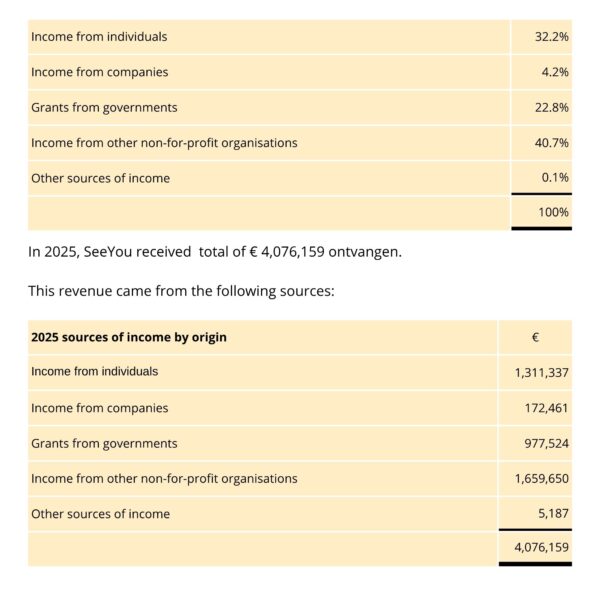
Total income of over 4 million euros in 2025 were more than 15% over the budget. This allowed us to reach more people, especially through the screening programmes for the early detection and treatment of eye conditions.
Higher contributions from private individuals and funds compensated for the lower income from companies and the government. We are using this growth in income to expand our project portfolio, thereby creating economies of scale and distributing costs more efficiently.
Gifts from individual donors and companies
- Thanks in part to large donations and legacies, income from individual donors was 67% over our budget. The meetings for entrepreneurs organised by the SeeYou Grow Network were also successful.
- Income from companies was slightly less than in 2024. This is partly because entrepreneurs donated more often privately or through foundations.
Government grants
In 2025, we once again received grants from the Ministry of Foreign Affairs and the European Union.
- The We Are Able! programme (2021–2025) was successfully completed.
- Since 2023, an EU project (MUB – Our Health, Our Skills, Our Future) has been running in Rwanda, with an annual contribution of approximately €150,000 for a period of three years.
Income from other non-profit organisations
With income from non-profit organisations, over €1.6 million was spent on projects in Ethiopia, Indonesia, Cambodia, and Rwanda, among others. Thanks to a number of new funds and increased contributions, the income from funds and foundations was:
- over €400,000 higher than in 2024
- more than €200,000 higher than budgeted
Expenditure
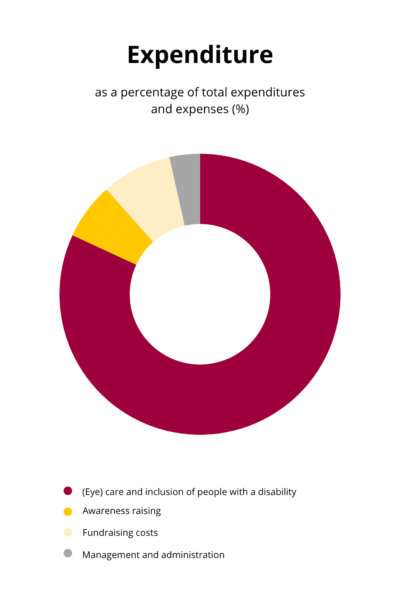
We were able to spend 88.4% of the total expenditure of €3,760,294 on our objectives (budgeted: 85.3%). This higher percentage is partly due to lower organisational costs: in 2025, costs were below the amount budgeted.
Organisational costs
We incur part of the organisational costs for the purpose of projects. We can partially allocate these costs to projects, within the agreed margins. We strive to fully cover our organisational costs through scaling up and continuously improving our efficiency. Management and administrative costs were lower in 2025, primarily due to a decrease in personnel costs.
|
Category |
Realisation 2025 |
Budgeted 2025 |
Realisation 2024 |
|
Management and administration |
3.5% |
6.0% |
4.9% |
|
Fundraising |
8.1% |
8.8% |
7.8% |
Personnel costs
Despite wage increases, our personnel costs have decreased again. That is thanks to:
- A reduction in hours, as the average number of FTEs decreased to 10.9 (2024: 11.5; 2023: 12.75)
- The departure of employees
- A more efficient organisational structure
Result allocation
We closed the financial year 2025 with a positive balance of €332,525 (compared to €292,900 in 2024).
Allocation:
- Allocated funds: €227,524
- Continuity reserve: €105,001
Reserves policy
Within the non-profit sector, we speak of reserves rather than equity, because funds always have a specific purpose. We use these reserves to ensure continuity and the absorption of risks.
Our reserves at the end of 2025:
Continuity Reserve: € 1,175,141
- The Continuity Reserve remains well below the sector standard (maximum 150% of annual costs). We apply our own standard of at least 65%. For 2025, it is 84%.
- Emergency Relief Reserve: € 75,000
The Emergency Relief Reserve was not used in 2025, but it remains available for rapid deployment in emergency situations.
Allocated funds
Allocated funds concern donations earmarked for specific projects or programmes. These show a positive development:
- Balance end of 2024: €1,024,498
- Balance end 2025: €1,252,022
This increase contributes to continuity and efficient project planning and is primarily due to:
- Early fundraising for future years
- Multi-year projects
Standard percentages and benchmark
Our starting point is that our cost percentages for fundraising, management and administration remain below the applicable benchmark set by the Dutch charity sector organisation Goede Doelen Nederland. The income is used to achieve the statutory objective.
The effective and sustainable implementation of this objective requires investments in fundraising and quality improvement. With this, we contribute to the continuity of our organisation, the quality of the programmes, and the support of our partners.
In the table below, the cost percentages realised by See You are compared with the benchmark for fundraising institutions in the peer group International aid and human rights with an annual income exceeding 1 million euros.
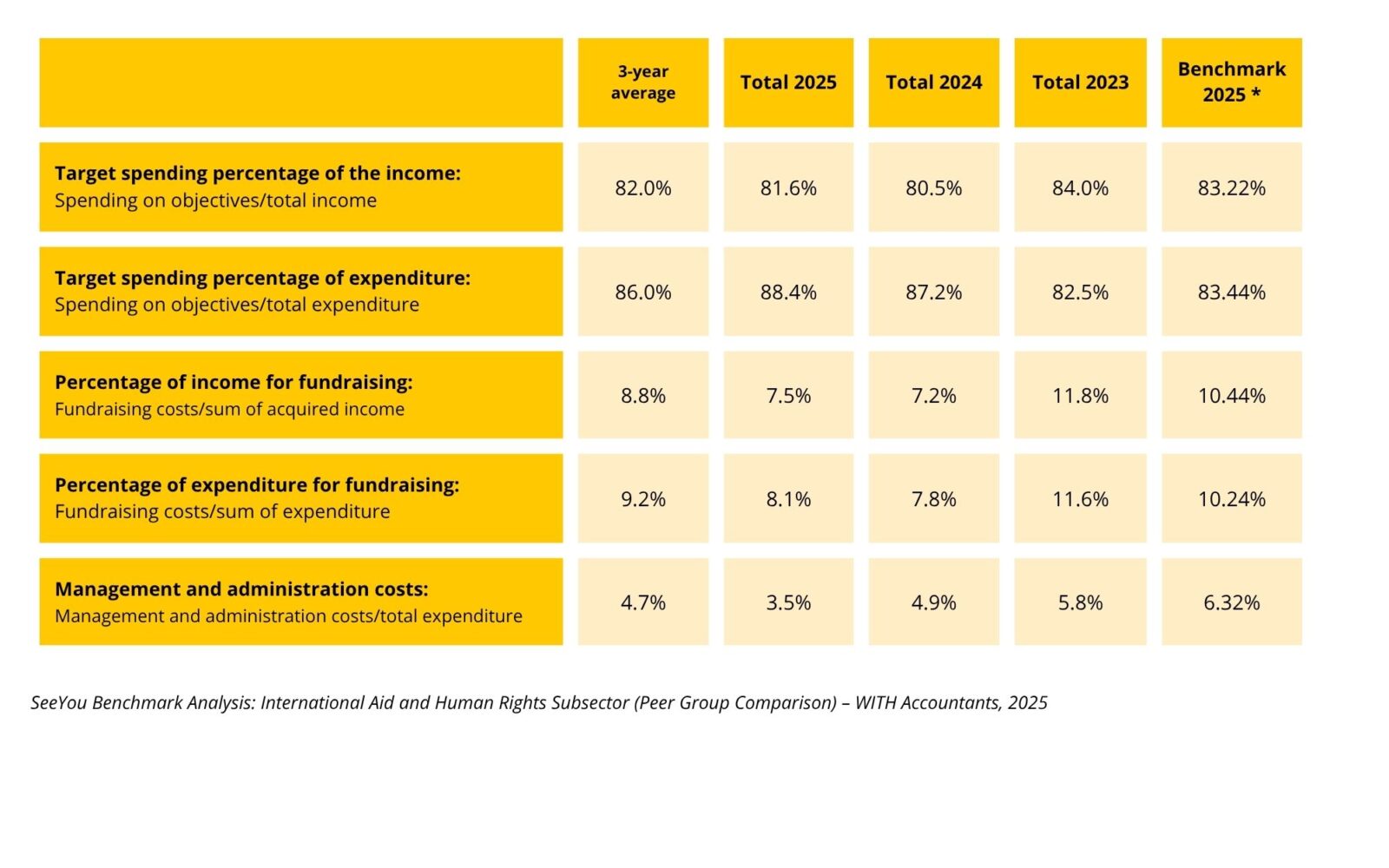

- The management and administration cost percentage is also below the benchmark in 2025. The decrease compared to 2024 is partly due to a decline in personnel costs.
- The target expenditure percentage of expenditure amounts to 88.4% in 2025, compared to a benchmark of 83.4%. Therefore, the three-year average for 2023–2025 is 86%, indicating that our organisation consistently performs above the benchmark.
- The percentage of fundraising costs increased slightly in 2025 compared to 2024. This increase is related to an intensification of fundraising activities, partly as a result of the decline in government funding. The percentage remains within the applicable benchmark.
Budget 2026
The 2026 budget is balanced, partly thanks to the use of allocated funds from 2025.
Key developments:
- Discontinuation of We Are Able! (approximately €1 million per year)
- Partial compensation through portfolio expansion
- Further commitment to programmatic financing
- Advance fundraising
Key priorities for 2026:
- New fundraising strategies due to declining government support
- More focus on non-earmarked donations
- Growth of programmatic donations
- Further cost control
- Scaling up projects and expanding the portfolio
Financial overview:
- Expected income: €2.8 million
- Result: -€773,753 (covered by allocated funds)
- Operating result: €4,306 positive
The 2026 budget is included as an annex to the 2025 financial statements.
Multi-year budget (2025–2029)
The multi-year budget aligns with our new multiannual strategy 2026–2030 and shows a positive outlook. Thanks to timely scaling up and cost control, we remain a financially healthy and agile organisation in a dynamic world.
Four important trends:
- Reduction in government grants
- Scaling up our projects and portfolio
- Growth through funds, companies, and individual donors
- Further professionalisation and efficiency improvements
Conclusion
We concluded 2025 as a financially healthy organisation with:
- strategic partners
- a high target spending
- strong cost control
- growing flexibility in funding
This forms a solid foundation for further impact and sustainable growth in the coming years.
2025 13. Learning and looking ahead

13
Learning and looking ahead
What we have learned from 2025
- We can make the impact and results of our programmes even more visible and transparent for our donors.
- We need to further shape our partnership policy to achieve sustainable development.
- We need to more fully integrate collaboration with organisations of persons with disabilities (OPDs) into our monitoring and evaluation.
- The new setup of a major eye care campaign for SeeYou Eye Health, with a concrete target for eye treatments, was well received.
- The increased focus on our relationship with funds and foundations, and major donors was successful and led to greater engagement.
Looking ahead to 2026
Looking ahead to 2026, we remain committed to quality eye care, accessible healthcare, education, and equal rights for persons with disabilities.
- We will expand our strategic partnerships and focus on further growth in our income and programme portfolio.
- We will set up a system for the structured storage of complaints, enabling us to analyse them, draw structural lessons, and further strengthen processes where necessary. We are also improving our ICT system.
- We revised our integrity policy in 2025 and will reformulate the code of conduct in 2026.
- We will expand SeeYou Eye Health. In Ethiopia, we will bring eye care to Afar, a remote region with severely limited eye care facilities. And in Tanzania, we will start a new project to prevent blindness together with the Kilimanjaro Christian Medical Centre and Light for the World Belgium.
- We will carefully conclude the final year of the Access to a Future project in Rwanda by strengthening the advocacy organisations involved. Thanks to funding from the European Union, we can invest specifically in a healthy and meaningful future for young persons with disabilities.
- We will work with our expert partners from SeeYou Learns in Rwanda and Indonesia on new projects to improve the enrolment of pupils with disabilities in pre-school and primary education.
- In accordance with our multi-year strategy for 2026-2030, we will devote even more attention to structurally improving the lives of families and to their impactful stories.
- We will continue our campaign for 50,000 eye treatments and develop new opportunities for donations and targeted fundraising.

Rawaa stands up for food security
Rawaa is a 25-year-old woman with a physical disability and hearing problems. From an early age onwards, her family encouraged her to participate in the community, but she remained very reserved out of fear of negative reactions to her disability. Even after joining the Women With Disabilities Association, Rawaa remained shy, reserved, and insecure. She avoided social gatherings, rarely spoke in public, and kept her opinions to herself, despite her sharp intellect.
Within the We Are Able programme, she participated in various training sessions on advocacy and self-empowerment. Gradually, Rawaa found more and more courage to voice her opinions. She became a trainer and participated in the Women Leaders’ Conference in South Africa, where she shared her story and advocated for the inclusion of women with disabilities. Recently, she was chosen as the female representative on the national advocacy team for inclusive food security, something she would have never dreamed of doing before. This means that Rawaa will engage in dialogue with ministries and government agencies to advocate for safe, fair, and accessible food systems for persons with disabilities!
2025 14. Final statements
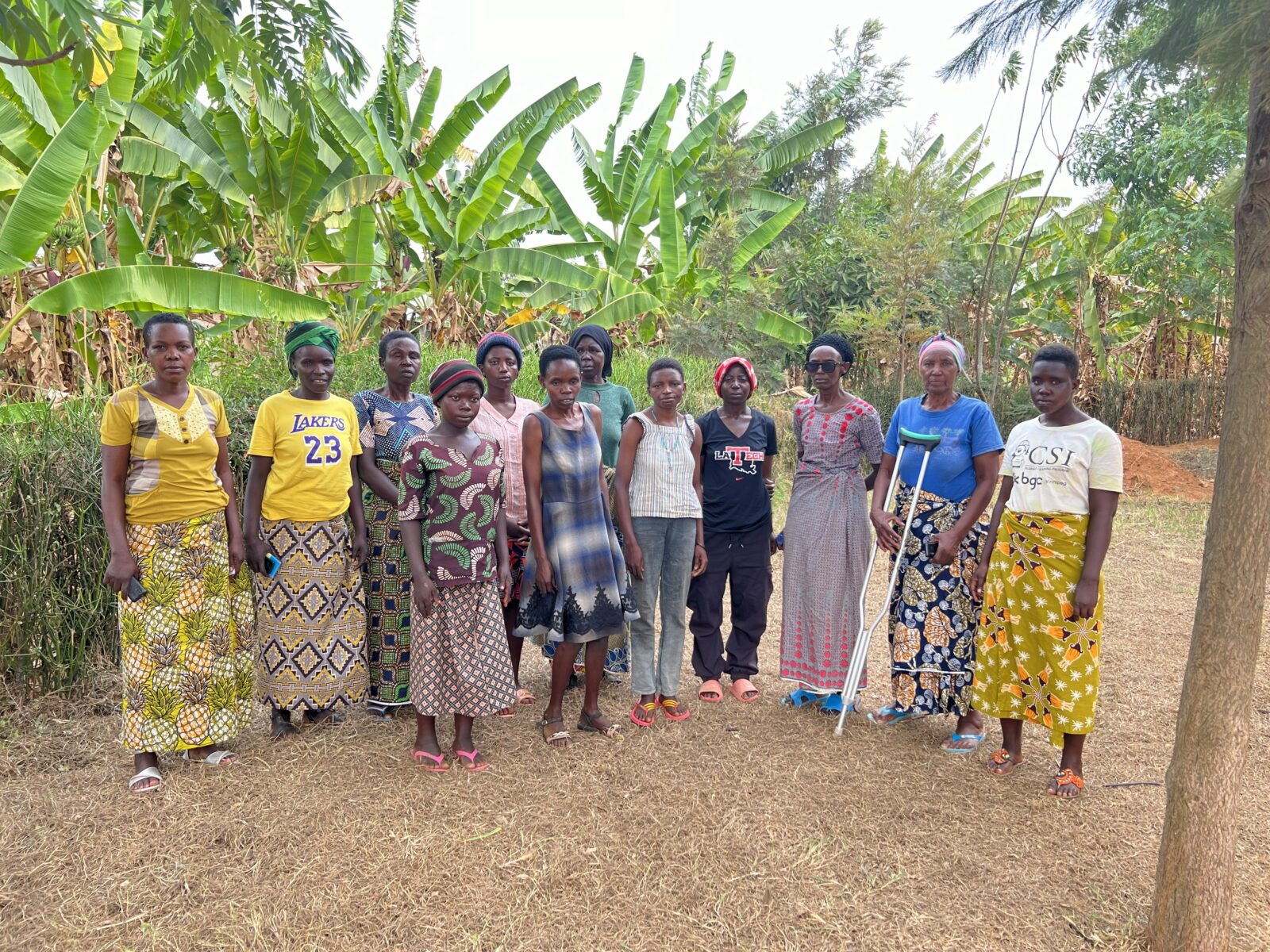

14
Final statements
1. Balance sheet on 31 December (after allocation of profits and/or losses)
| Assets | 31/12/2025 | 31/12/2024 | |
|---|---|---|---|
| € | € | ||
| Fixed assets | |||
| Tangible assets | 7.1 | ||
| Buildings | 37,989 | 37,989 | |
| Inventory and IT | 49,784 | 42,113 | |
| Vehicles | - | - | |
| 87,773 | 80,102 | ||
| Financial assets | |||
| Receivables | 7.2 | ||
| Project contributions to be received | 43,166 | 69,622 | |
| Project contributions paid in advance | 271,903 | 83,174 | |
| Legacies to be claimed | 238,401 | 198,624 | |
| Other receivables and assets | 16,759 | 19,733 | |
| 570,229 | 371,153 | ||
| Liquid assets | 7.3 | 2,526,137 | 3,136,889 |
| Total assets | 3,184,137 | 3,588,144 | |
| Liabilities | 31/12/2025 | 31/12/2024 | |
| € | € | ||
| Reserves and funds | 7.4 | ||
| Reserves | |||
| Continuity reserve | 1,175,141 | 1,070,140 | |
| Emergency aid reserve | 75,000 | 75,000 | |
| Mission implementation reserve 2021-2024 | - | - | |
| 1,250,141 | 1,145,140 | ||
| Funds | |||
| Allocated funds | 1,252,022 | 1,024,498 | |
| Provisions | 7.5 | ||
| Income payment obligation | 259,293 | 285,782 | |
| 259,293 | 285,782 | ||
| Current liabilities | 7.6 | ||
| Debts related to projects | 204,336 | 898,009 | |
| Taxes and social security contributions | 76,842 | 95,134 | |
| Other current liabilities personnel | 75,930 | 78,466 | |
| Other current liabilities | 65,567 | 61,109 | |
| 422,675 | 1,132,718 | ||
| Total liabilities | 3,184,137 | 3,588,144 |
2. State of income and expenditure
| Income | Realisation 2025 | Budget 2025 | Realisation 2024 | |
|---|---|---|---|---|
| € | € | € | ||
| Income from individuals | 8.1 | 1,311,337 | 786,375 | 1,553,178 |
| Income from companies | 8.2 | 172,461 | 246,500 | 98,681 |
| Grants from governments | 8.3 | 927,524 | 1,073,934 | 1,206,569 |
| Income from other non-for-profit organisations | 8.4 | 1,659,650 | 1,401,427 | 1,272,582 |
| Sum of income raised | 4,070,972 | 3,508,236 | 4,131,010 | |
| Other income | 8.5 | 5,187 | 1,000 | 2,580 |
| Total icome | 4,076,159 | 3,509,236 | 4,133,590 | |
| Expenditure | ||||
| € | € | € | ||
| Spent on objective | ||||
| (Eye)care and inclusion for people with disabilities in project countries | 5 | 3,081,156 | 3,223,770 | 3,078,283 |
| Awareness raising | 5 | 243,293 | 249,780 | 250,798 |
| 3,324,449 | 3,473,550 | 3,329,081 | ||
| Fundraising | ||||
| Fundraising costs | 5 | 304,907 | 358,214 | 299,547 |
| Management and administration | ||||
| Management and administration costs | 5 | 130,939 | 243,230 | 187,318 |
| Sum of expenditure | 3,760,295 | 4,074,994 | 3,815,946 | |
| Balance before financial income and expenditure | 315,864 | -565,758 | 317,644 | |
| Balance financial income and expenditure | 9.8 | 16,664 | 10,000 | -24,744 |
| Profit/Loss | 332,525 | -555,758 | 292,900 |
3. Allocation of profits and/or losses
| Realisation 2025 | Budget 2025 | Realisation 2024 | |
|---|---|---|---|
| Allocation of reserves | € | € | € |
| Continuity reserve | 105,001 | 65,135 | 110,003 |
| Emergency aid reserve | - | - | - |
| Reserve to cover explotation 2020 | - | - | - |
| Mission implementation reserve 2021-2024 | - | - | -235,438 |
| 105,001 | 65,135 | -125,435 | |
| Allocation of result funds | |||
| Allocated funds | 227,524 | -620,893 | 418,335 |
| Total | 332,525 | -555,758 | 292,900 |
Just like 2024, 2025 also closes with a positive result. Project revenues still available at the end of 2024 were spent in 2025. New income was generated throughout the year, meaning we will conclude 2025 with a substantial portion of the allocated funds still available to spend on projects and programmes. This made it possible to renew contracts promptly and offer partners certainty. With this, the allocated funds have once again been deployed for full expenditure in the coming period.
This year, legacies once again made a positive contribution to supporting SeeYou in general.
Our policy concerning the reserves is further explained in the Notes to the balance (7.4).
You can find an explanation of the Results in the Explanation (Sections 8 and 9) and in Section 11, Comparative analysis. In addition, the Finances chapter of the Annual Report 2025 provides further details on the financial policy and results.
4. Cash flow statement
| 2025 | 2024 | |||
|---|---|---|---|---|
| Cash flow from operational activities | € | € | ||
| Total income | 4,076,159 | 4,133,590 | ||
| Total expenditure | 3,760,295 | 3,815,946 | ||
| Operating result | 315,864 | 317,644 | ||
| Adjustmets for: | ||||
| Amortisations and depreciations | 13,110 | 19,551 | ||
| Changes in provisions | -26,489 | 9,995 | ||
| -13,379 | 29,546 | |||
| Changes in operating capital | ||||
| Receivables | -199,076 | 412,567 | ||
| Current liabilities | -710,043 | -75,793 | ||
| -909,119 | 336,774 | |||
| Cash flow from operational activities | -606,634 | 683,964 | ||
| Interest received | - | - | ||
| Interest paid | - | - | ||
| Income and expenditure | 16,664 | -24,744 | ||
| 16,664 | -24,744 | |||
| Total cash flow from operational activities | -589,970 | 659,220 | ||
| Total cash flow from investment activities - Investments in other financial assets | ||||
| Investments in material and financial fixed assets | -20,781 | - | ||
| Disposal of material and financial fixed assets | - | -27,742 | ||
| Total cash flow from investment activities | -20,781 | -27,742 | ||
| Cash increase/decrease | -610,752 | 631,480 | ||
| Position liquid funds on 31-12 | 2,526,137 | 3,136,889 | ||
| Position liquid funds on 1-1 | 3,136,889 | 2,505,407 | ||
| Increase/decrease in cash | -610,752 | 631,480 | ||
| The cash flow statement has been prepared using the indirect method. |
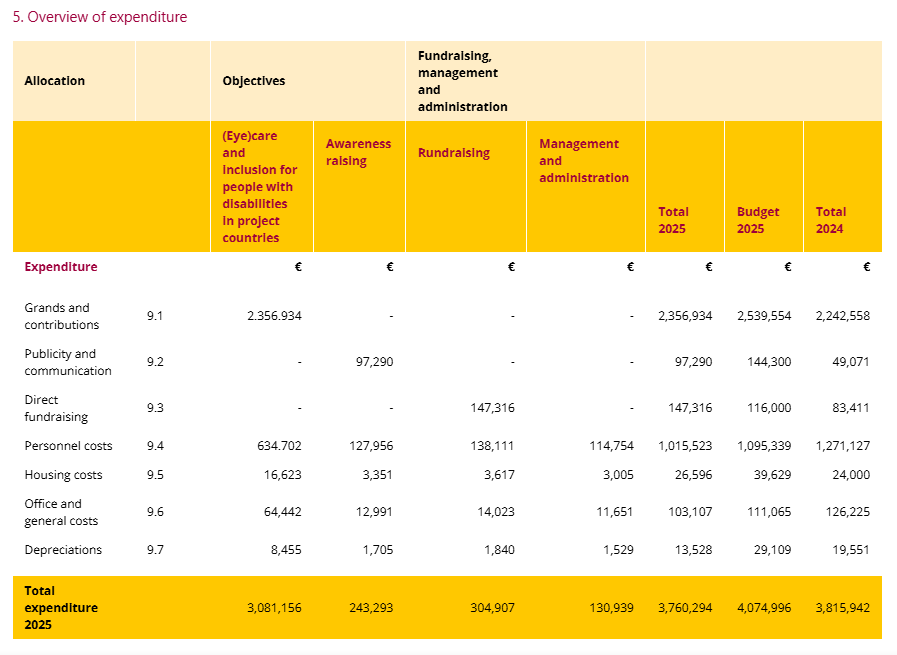

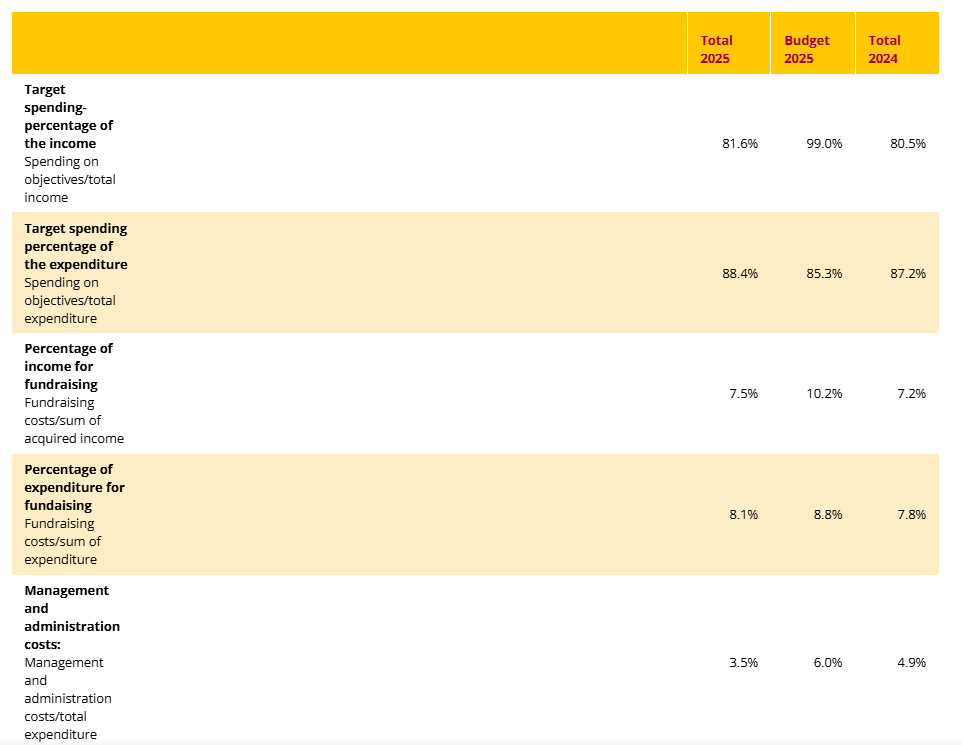

6. Accounting policies
General accounting policies
These annual financial statements have been drawn up in accordance with Guideline 650 for Fundraising Organisations, as set out in the Dutch Guidelines for Annual Reporting (as adjusted in 2024). The purpose of this Guideline is to provide insight into the organisation’s costs and how funds are spent in relation to the purpose for which they were raised. The financial statements have been drawn up in euros.
The SeeYou Foundation has a Directorate-Supervisory Board model. The directorate has one member, the Executive Director.
Comparative figures
The comparative figures for 2024 have been adjusted where relevant to allow comparability with the year under review.
Consolidation
The board of the SeeYou Foundation is also the board of the Open Oog Foundation (‘Open Eye Foundation’). The annual financial statements of the SeeYou Foundation do not include consolidated figures for the result and equity of the Open Oog Foundation, as the foundation’s significance is generally negligible.
Continuity assumption
The valuation of assets and liabilities in the financial statements is based on the continuity assumption. In the short term, there are no threats to the continuity of the organisation.
Cash flow statement principles
The cash flow statement has been drawn up using the indirect method. The cash and cash equivalents in the cash flow statement consist of liquid assets, being cash and bank balances.
The cash flows are distinguished into:
- cash flows from operating activities
- cash flows from investing activities
Interest received and paid are recorded under cash flow from operating activities.
Cash flows from investing activities relate to expenditures concerning tangible fixed assets.
The change in cash in the cash flow statement reconciles with the change in cash and cash equivalents as recorded in the balance sheet.
Estimates
In drawing up the annual accounts, management uses estimates and assumptions that affect the valuation of assets and liabilities and the determination of the result. Actual results may differ from these estimates.
The payment obligation is estimated based on the price index of Statistics Netherlands (Dutch abbreviation: CBS).
Valuation principles
General valuation principles
Unless stated otherwise, assets and liabilities are listed at their amortised cost.
Currency conversion
A transaction in a foreign currency is measured on initial recognition at the functional exchange rate on the transaction date. For a transfer to a euro account, the transaction date is the date the transfer is made from the euro account to the local euro account. For transfers to a local currency account, the exchange rate at the time of receipt by the transfer partner applies. Monetary balance sheet items in foreign currency are converted at the functional exchange rate on the balance sheet date.
Exchange differences arising during the settlement or conversion of monetary items in foreign currency are included in the statement of income and expenses.
Tangible fixed assets
The tangible fixed assets necessary for carrying out the organisation’s objectives and business operations are valued at their acquisition price, less depreciation calculated on the estimated useful life, taking into account any residual value. Depreciation is calculated as a percentage of this acquisition price.
Receivables, liquid assets, debts and accrued assets and liabilities
The receivables, liquid assets, debts, accrued assets and liabilities are stated at amortised cost; the valuation is made after deducting a provision for doubtful debts, based on an individual assessment of the receivables.
Project obligations are included based on a decision to that effect, which is made known in writing to the recipient of the grant and are charged to the financial year in which the project activities must be carried out by the partner implementing the project.
Reserves and funds
Reserves constitute money that SeeYou is free to use within the frameworks of RJ650 and the CBF. Allocated reserves may be earmarked by the board to be used for a specific purpose.
Funds concern money that must be spent within the context of the purpose for which these were made available. This concerns the unspent part of earmarked donations and other funds included under income.
Provisions
Provisions are listed when it is probable or certain that a liability will arise, but for which the size or timing of the disbursement of funds is not known.
Accounting principles for the determination of results
General accounting principles for the determination of results
Profit is determined as the difference between the income and all related costs and other expenses attributable to the reporting year, with due observance of the aforementioned accounting principles.
Income
Income consists of all revenues attributable to the reporting year.
Legacies are included in the reporting year in which the size of the estate can be reliably estimated. Advances are recognised in the financial year in which they are received. In-kind donations are valued at fair market value.
Government grants
Government grants are recognised in the annual accounts as soon as the grant has been awarded. Revenues are recognised based on the actual expenditures of the subsidised project as listed in the budget. If grants have already been received but the conditions have not yet been met, they are recorded as short-term liability.
Other non-profit organisations
Income from other non-profit organisations is accounted for under income from third-party activities in the statement of income and expenses for the year to which they relate.
These benefits are recognised as soon as the right to receive has arisen and the amount can be reliably determined.
If conditions are attached to the income, it shall only be recognised as income to the extent that there is sufficient certainty that the conditions are met. Unspent amounts with a specific purpose are added to the relevant allocated funds.
Expenses
Financial income and expenses concern the interest paid and received in the reporting period.
Employee compensation
Salaries and social security contributions are allocated to the reporting period in which they are due, in accordance with the employment contracts.
The pension scheme is administered by the sector pension fund Pensioenfonds Zorg en Welzijn (PFWZ). As of 1 January 2026, this pension fund has switched to the new pension rules under the Pensions Future Act (Dutch abbreviation Wtp). SeeYou has promised its personnel a pension under an average-earnings plan. Between 2026 and 2028, this will shift to a defined premium scheme in which participants build up personal pension assets. The old situation still applies for 2025.
The premiums due for the financial year are accounted for as expenses.
A liability is recognised for premiums not yet paid as of the balance sheet date. The risks for
price indexation and investment return may potentially lead to an adjustment of
future contributions to the pension fund PFWZ. These risks are not reflected in a provision included in the balance sheet. In the case of a deficit at the pension fund PFWZ, SeeYou has no obligation to make additional contributions other than future higher premiums.
The pension fund PFWZ shares the following annual statement for 2025.
The current funding ratio of the pension fund PFWZ increased from 109.8% to 125.7% from 1 January 2025 to 31 December 2025. The policy coverage ratio has increased from 108.9% to 117.7%. The increase in the current funding ratio was primarily caused by the rise in market interest rates. With the investments, pension fund PFZW achieved an annual return of -3.9%. Total invested assets will have decreased from €259.1 billion to €251.4 billion in 2025.
1 January 2026
(Annual Statement Pensioenfonds Zorg en Welzijn 2025 – PFWZ.nl)
Cost allocation
Personnel costs, accommodation costs, office and general expenses, and depreciation are allocated proportionally to the objective, recruitment benefits, and management and administration.
7. Notes to the balance sheet
7.1 Tangible fixed assets
| The movements in tangible fixed assets are summarized in the schedule below: | ||||
|---|---|---|---|---|
| 7.1 Tangible fixed assets | Buildings | Inventory & IT | Vehicles | Total |
| € | € | € | € | |
| Situation on 1 January 2025 | ||||
| Purchase value | 187,593 | 240,152 | - | 427,745 |
| Accumulated depreciation | -149,604 | -198,039 | - | - |
| 37,989 | 42,113 | - | 427,745 | |
| Changes in fiscal year 2025 | ||||
| Investments | - | 20,781 | - | 20,781 |
| Depreciations | - | -13,110 | - | -13,110 |
| Disposals | - | - | - | - |
| Cost of disposals | - | - | - | - |
| - | 7,671 | - | 7,671 | |
| Situation on 31 December 2025 | ||||
| Purchase value | 187,593 | 260,933 | - | 448,526 |
| Accumulated depreciation | -149,604 | -211,149 | - | -360,753 |
| 37,989 | 49,784 | - | 87,773 | |
| Depreciations are calculated based on the following annual depreciation percentages: | ||||
| Buildings (excluding land) | 3% | |||
| Inventary and automation | 10% - 25% | |||
| Vehicles | 20% | |||
| WOZ building value reference date 1-1-2023 1-1-2024 | 99,000 |
7.2 Explanation of the balance sheet – Financial assets
| 7.2 Receivables | 2025 | 2024 |
|---|---|---|
| € | € | |
| Project contributions to be received | 43,166 | 69,622 |
| Prepaid project contributions | 271,903 | 83,174 |
| Legacies to be received | 238,401 | 198,624 |
| Other receivables | ||
| Contributions to be received | - | 2,824 |
| Accured interest | 8,121 | 7,294 |
| Prepaid contributions | 8,638 | 9,615 |
| Total other receivables | 16,759 | 19,733 |
| Balance on 31 December | 570,229 | 371,153 |
| A provision for ineligibility is not considered necessary. |
7.3 Explanation of the balance sheet – Liquid assets
| 7.3 Liquid assets | 2025 | 2024 |
|---|---|---|
| € | € | |
| Cash | 853 | 1,770 |
| Bank account - current accounts | 386,454 | 1,622,846 |
| Bank account - US dollar | 556 | 977 |
| Bank account - savings | 2,138,274 | 1,511,296 |
| Balance on 31 December | 2,526,137 | 3,136,889 |
| The liquid assets are freely available | ||
| The bank account in US dollars is valued according to th exchange rate on the balance date. |
7.4 Reserves and funds
| 7.4 Reserves and funds | 31-12-2025 | 31-12-2024 | ||
|---|---|---|---|---|
| Reserves | € | € | ||
| Continuity reserve | 1,175,141 | 1,070,140 | ||
| Emergency aid reserve | 75,000 | 75,000 | ||
| Mission implementation reserve 2021-2024 | - | - | ||
| Total | 1,250,141 | 1,145,140 | ||
| The development can be displayed as follows: | Balance on 1 Jan | Allocation of profits and/or losses | Other changes | Balance on 31 Dec |
| Continuity reserve | 1,070,140 | 105,001 | - | 1,175,141 |
| Emergency aid reserve | 75,000 | - | - | 75,000 |
| Mission implementation reserve 2021-2024 | - | - | - | - |
| Total | 1,145,140 | 105,001 | - | 1,250,141 |
There is a slight increase in reserves compared to 2024, driven by improved coverage of the SeeYou costs, particularly from programmatic contributions.
The reserves are segmented according to the purpose assigned to them by the board. In 2025, these were the Continuity Reserve and the Emergency Relief Reserve. The Continuity Reserve is a financial buffer for recognised charities, under the CBF guidelines. It ensures that the organisation can bridge disappointing income (from donations, grants) for some time and, if necessary, take measures to reduce costs, and is considered part of good governance. SeeYou establishes the minimum size of the Continuity Reserve based on a risk analysis. The guiding principle is that the reserve must enable SeeYou to redress temporary setbacks so that projects can continue to achieve their results or, in the worst-case scenario, be properly wrapped up. This means that donations continue to be used well even when financial setbacks occur. As an organisation, SeeYou needs to be able to bridge such a financial dip and also provide short-term support to partners, for example, when support is suddenly withdrawn. Stability also allows a partner to better build sustainable local capacity rather than engage in ad hoc crisis management.
Since 2025, SeeYou has maintained a position of at least 65% of the organisation’s gross costs for the Continuity Reserve. The charity sector applies a maximum of 150% of the organisation’s annual costs; SeeYou remains well below that.
7.4 Continuity reserve
| 2025 | 2024 | |
|---|---|---|
| Continuity reserve | € | € |
| Balance on 1 January | 1,070,140 | 960,137 |
| Change according to allocation of profits and/or losses | 105,001 | 110,003 |
| Balance on 31 December | 1,175,141 | 1,070,140 |
| Target level of the continuity reserve: 65% of annual operating expenses | ||
| Annual expenses | 1,403,360 | |
| Continuity reserve in Euro | 1,175,141 | |
| Continuity reserve in % | 84% |
Earmarked reserves
In addition to the Continuity Reserve, SeeYou has established one earmarked reserve:
- Emergency Relief Reserve: €75,000
The countries where SeeYou collaborates with partners are also regularly affected by natural disasters, conflicts, and other unexpected emergencies, such as the coronavirus pandemic. To respond quickly in these situations, a reserve has been established to immediately start and (pre-)finance initial activities, independent of fundraising. SeeYou supports partners in need on humanitarian grounds, provided that the local or international partners have the capacity to provide this assistance adequately. This also supports the progress of regular activities.
Any funds raised for this emergency aid will subsequently be returned to the reserve until the pre-financing position is replenished. This ensures that funds can be quickly made available again for a new emergency relief operation and deployed to benefit victims of natural disasters, conflicts, or other unexpected emergencies.
In 2025, these emergency relief funds were not called upon. However, emergency situations did arise, particularly in Rwanda due to border conflict and the sudden loss of third-party funding. Existing donors stepped in immediately, without the need for bridging from the emergency fund.
7.4 Emergency Aid reserve
| 2025 | 2024 | |
|---|---|---|
| Emergency Aid reserve | € | € |
| Balance on 1 January | 75,000 | 75,000 |
| Change according to allocation of profits and/or losses | - | - |
| Balance on 31 December | 75,000 | 75,000 |
7.4 Allocated funds
| 2025 | 2024 | |
|---|---|---|
| Allocated funds | € | € |
| Balance on 1 January | 1,024,498 | 606,163 |
| Additions | 2,294,703 | |
| Withdrawals | -2,067,179 | |
| Change according to allocation of profits and/or losses | 227,524 | 418,335 |
| Balance on 31 December | 1,252,022 | 1,024,498 |
The funds allocated as of 31 December 2024 have all been deployed to projects in 2025. New funds were raised again during 2025. Some of these funds were confirmed in the second half of the year and were therefore not fully spent in the financial year 2025. SeeYou also strives to raise funds on time. With the funds available at the end of the financial year, the contracts for the projects can be signed with the partners in a timely manner, without inefficient interruptions while awaiting new funding. Multi-year funding and advance fundraising both contribute to this.
7.5 Provisions
| 2025 | 2024 | |
|---|---|---|
| Income payment obligation | € | € |
| Balance on 1 January | 285,782 | 275.788 |
| Endowment | 6,570 | 43,182 |
| Payments | -33,059 | -33,188 |
| Balance on 1 December | 259,293 | 285,782 |
This provision was formed as a result of an inheritance received. Stichting SeeYou has taken upon itself the obligation to pay out this inheritance to the heirs of this estate. The payment is dependent on various factors, including indexation based on the Dutch Consumer Price Index. The provision is based on an actuarial calculation. The actuarial interest rate in 2025 is 3.26% (2024: 3.300%, 2023: 3.00%) based on the mortality table (male and female mortality between 2014 and 2019) using the SRA method.
7.6 Current liabilities
| 2025 | 2024 | |
|---|---|---|
| € | € | |
| Liabilities related to projects | ||
| Project obligations | - | 116,986 |
| Amount still to be settled with implementing partners | 108,938 | 88,956 |
| Amount received in advance from donors for ongoing projects | 46,398 | 632,547 |
| Amount received in advance for projects still to be started | 49,000 | 59,520 |
| 204,336 | 898,009 | |
| Taxes and social security contributions | ||
| Payroll tax and social security contributions to be paid | 53,112 | 53,198 |
| Pension contribution to be paid | 23,730 | 41,936 |
| Balance on 31 December | 76,842 | 95,134 |
| Other current liabilities personnel | ||
| Provision for holiday pay including social security contributions | 30,829 | 31,384 |
| Provision for end-of-year bonus | - | 8,107 |
| Provision for annual leave | 45,101 | 38,975 |
| Other liabilities personnel | - | - |
| 75,930 | 78,466 | |
| Other liabilities | ||
| Account payable | 52,110 | 37,725 |
| Other current liabilities | 13,457 | 23,384 |
| 65,567 | 61,109 | |
| Balance on 31 December | 422,675 | 1,132,718 |
7.7 Rights and obligations not included in the balance sheet
Multi-year financial obligations
An annual lease has been signed for our office space that runs from 1 August 2022 to 31 July 2027. The rent is indexed annually based on the Dutch Consumer Price Index. The total of the lease instalments that expire after the balance sheet date amounts to approximately €28,900 – €13,195 = €15,705 (price level 2024
Conditional advances
If partners do not spend all of the project funds allocated during the project period concerned, there is underspending. SeeYou Foundation then has the conditional right to reclaim these funds.
Underspending, once determined and communicated to the partner, is usually settled during the following agreed project period.
7.8 Events after the balance sheet date
The 5-year We Are Able! project ended on 31 December 2025. During the preparation of the final report by all consortium partners, an unforeseen overspend was identified in Q1 2026, resulting in partial adjustments to previous cost coverage agreements, agreed upon in consultation within the consortium. The SeeYou share in this has been calculated at 23,510 euros. That has been deducted from the assets and receivables.
8. Explanation of the income
| Realisation 2025 | Budget 2025 | Realisation 2024 | |
|---|---|---|---|
| 8.1 Income from individuals | € | € | € |
| Individuals | 406,856 | 436,375 | 417,221 |
| Major donors | 735,000 | 250,000 | 375,000 |
| Legacies and estates | 169,481 | 100,000 | 760,957 |
| 1,311,337 | 786,375 | 1,553,178 | |
| 8.2 income from companies | € | € | € |
| Companies | 168,655 | 243,500 | 95,673 |
| Opticians | 3,806 | 3,000 | 3,008 |
| 172,461 | 246,500 | 98,681 | |
| 8.3 Grants from governments | € | € | € |
| Dutch Ministry of Foreign Affairs: We Are Able! | 828,029 | 870,970 | 1,055,428 |
| European Union: MUB | 99,495 | 202,964 | 151,141 |
| 927,524 | 1,073,934 | 1,206,569 | |
| 8.4 Income from other non-for-profot organisations | € | € | € |
| Funds and foundations | 1,438,104 | 1,184,677 | 1,154,231 |
| International foundations | - | - | - |
| Churches | 54,848 | 70,000 | 53,834 |
| Schools | 823 | 1,000 | 600 |
| Service Clubs | 250 | 3,000 | - |
| EO Metterdaad | 165,625 | 142,750 | 63,917 |
| 1,659,650 | 1,401,427 | 1,272,582 | |
| 8.5 Other income | € | € | € |
| Miscellaneous | 5,187 | 1,000 | 2,580 |
| 5,187 | 1,000 | 2,580 |
Income in 2025 is higher than budgeted. Income from individual donors is reasonably stable. This also includes long-term authorisations. Donations from major donors and legacies form an important part. They can vary significantly and are therefore budgeted conservatively. In 2025, those revenues are well above budget, as are those from funds and foundations, partly due to intensive fundraising.
The funds donated by other non-profit organisations primarily concern project contributions on an annual basis. The programme We Are Able! (2021-2025) and the EU-funded MUB (2023-2026) fall under government grants. We Are Able! is settled annually; the determination for 2025 has not yet been made. The MUB spans 3 years, and shifts within the project years are possible. The total for 3 years remains the same. Within this framework, 2025 is budgeted too high.
9.1 Grants and contributions for project implementation by partner organizations
| Realisation 2025 | Budget 2025 | Realisation 2024 | |
|---|---|---|---|
| Programm | |||
| SeeYou Eye Health | 1,076,566 | 1,214,247 | 949,606 |
| Inclusive Eye Health Ethiopia | 560,903 | 660,265 | 494,690 |
| Inclusive Eye Health Rwanda | 425,948 | 445,872 | 425,081 |
| Inclusive Eye Health Indonesia | 89,715 | 108,110 | 27,409 |
| Digital accessibility Ethiopie | - | - | 2,426 |
| SeeYou Cares | 409,401 | 427,973 | 330,639 |
| Every Life Matters Ethiopia | 143,787 | 151,785 | 135,644 |
| Every Life Matters Rwanda | 130,864 | 143,717 | 172,734 |
| Every Life Mattters Indonesia | 134,750 | 132,471 | 22,261 |
| Every Life Matters NLD | - | - | - |
| SeeYou Works | 96,005 | 107,307 | 19,505 |
| Employable GWWDs Rwanda | 96,005 | 107,307 | 19,505 |
| SeeYou Learns | 375,996 | 422,676 | 232,709 |
| Learning Unlocked PRY Indonesia (apr 24-march 25) | 38,750 | 37,643 | 103,303 |
| Learning Unlocked PRY Indonesia (apr 25-dec 25) | 93,648 | 118,589 | - |
| SeeYou Learns Rwanda | 72,174 | 71.976 | 17,610 |
| Inclusive Education Cambodia | 28,750 | 28,750 | 60,355 |
| Community Change Makers Indonesia | 706 | - | 51,441 |
| SeeYou Learns Ethiopia | 144,760 | 165,718 | - |
| PAfiD correction 2024 | -2,792 | - | - |
| SeeYou Rights | 1,016,761 | 1,076,646 | 1,257,035 |
| We are Able NLD/DCDD | 117,980 | 104,070 | 111,660 |
| We are Able South Sudan | 170,646 | 187,517 | 277,390 |
| We are Able Sudan | 209,852 | 232,791 | 290,092 |
| We are Able Uganda | 353,062 | 346,590 | 376,284 |
| MUB UPHLS Rwanda | 87,948 | 106,313 | 102,125 |
| MUB RNUD Rwanda | 46,037 | 51,024 | 54,064 |
| MUB SeeYou NLD | 31,236 | 48,341 | 45,420 |
| Partnership | 19,974 | 15,000 | 28,901 |
| PAfiD Capacity Development | - | - | 15,000 |
| Lobby & Advocacy | 17,005 | 15,000 | 13,901 |
| Koersverschillen (project)betalingen | 1,263 | ||
| Reiskosten projecten | 1,706 | ||
| Total | 2,974,729 | 3,248,849 | 2,818,395 |
| Charged on project costs | |||
| Salary costs charged to projects | -310,861 | -315,720 | -265,448 |
| Organisation costs charged to projects | -326,908 | -406,418 | -310,389 |
| -637,769 | -722,138 | -575,837 | |
| Net grants and contributions to partners for realised projects | 2,356,934 | 2,526,711 | 2,242,558 |
The project passed-through costs consist of direct project costs (e.g., travel, evaluations), programme management costs directly attributable to the projects, and organisational costs allocated to the projects.
9.2 Publicity and communication
| Realisation 2025 | Budget 2025 | Realisation 2024 | |
|---|---|---|---|
| € | € | € | |
| 9.2 Publicity and communication | |||
| Awareness raising | 23,927 | 40,000 | 13,767 |
| Publicity | 43,953 | 60,000 | 26,452 |
| Other | 29,410 | 44,300 | 8,852 |
| Total publicity and communication | 97,290 | 144,300 | 49,071 |
| 9.3 Direct fundraising costs | |||
| Mailings and marketing | 111,771 | 88,000 | 66,718 |
| Other fundraising costs | 35,545 | 28,000 | 16,693 |
| Total direct fundraising costs | 147,316 | 116,000 | 83,411 |
| 9.4 Personnel costs | |||
| Salaries | 676,450 | 730,009 | 764,419 |
| Social security contributions | 120,803 | 127,869 | 130,472 |
| Pensions | 67,042 | 87,043 | 78,452 |
| Sick leave insurance | 42,204 | 48,250 | 52,694 |
| Travel costs | 9,499 | 10,500 | 11,113 |
| International travel costs | - | 5,600 | 1,580 |
| Recruitment and hiring | - | 1,500 | 25,204 |
| Training and development | 2,741 | 10,000 | 8,698 |
| Hiring external expertise | 75,062 | 49,278 | 208,549 |
| Other personnel costs | 21,722 | 25,290 | -10,054 |
| Total personnel costs | 1,015,523 | 1,095,339 | 1,271,127 |
| Average number of employees | 10.9 |
Fundraising costs turned out higher than budgeted due to the deployment of a new online marketing strategy and an additional fundraising campaign.
Overall, personnel costs decreased slightly. The number of FTEs fell slightly further to an average of 10.9 (2024: 11.65, 2023: 12.75, and 2022: 15.26).
The costs for the Executive Director are accounted for under 10. Salaries
Members of the Supervisory Board receive no remuneration for their work. During the reporting year, no loans, advances, or guarantees were provided to them.
9.5 Housing costs
| Realisation 2025 | Budget 2025 | Realisation 2024 | |
|---|---|---|---|
| € | € | € | |
| 9.5 Housing costs | |||
| Rent for office space Vendelier 15 in Veenendaal | 13,195 | 13,500 | 12,311 |
| Water and enrgy costs | 3,256 | 5,500 | 4,045 |
| Other housing costs | 10,145 | 20,629 | 7,644 |
| Total housing costs | 26,596 | 39,629 | 24,000 |
| 9.6 Office and general expenditure | |||
| IT Costs | 49,773 | 50,815 | 48,688 |
| Bank fees | 6,590 | 6,500 | 6,065 |
| Accountants costs | 29,430 | 28,000 | 31,302 |
| Other | 17,314 | 25,750 | 40,170 |
| 103,107 | 111,065 | 126,225 | |
| 9.7 Depreciation costs | |||
| Buildings | - | 5,700 | 5,628 |
| Inventory and IT | 13,528 | 23,409 | 13,923 |
| Vehicles | - | - | - |
| Total depreciation costs | 13,528 | 29,109 | 19,551 |
| 9.8 Financial income and expenditure | |||
| -16,664 | -10,000 | -24,744 | |
| Total financial income and expenditure | -16,664 | -10,000 | -24,744 |
SeeYou strives to keep office costs as low as possible. Following the sharp rise in energy prices in 2022, energy-saving measures were implemented to control those costs. Under depreciation, automation started later in the year, resulting in a lower depreciation this fiscal year. The depreciation of buildings could be discontinued.
10. Salaries
The costs of the Executive Director have been significantly reduced this year due to fewer hours and lower remuneration.
10. Salaries
| 2025 | 2024 | |
|---|---|---|
| 10. Salaries | ||
| Ms J.G.H. Omvlee | ||
| Position: Executive Director | ||
| Contract | ||
| Type (duration) | Definite | Definite |
| Hours per week | 24 | 24 |
| Part-time percentage | 66.67 | 66.67 |
| Period | 01/01-31/12 | 01/12-31/12 |
| Annual remuneration | € | € |
| Gross salary | 58,846 | 4,861 |
| Holiday pay | 2,329 | 0 |
| End-of-year bonus | 5,264 | 435 |
| Pension costs | 7,601 | 640 |
| Total remuneration | 74,040 | 5,936 |
| Ms D.J. Nieuwenhuis | ||
| Position: Executive Director | ||
| Contract | ||
| Type (duration) | n.a. | Indefinite |
| Hours per week | 32 | |
| Part-time percentage | 88.89 | |
| Period | 01/01-31/12 | |
| Annual remuneration | ||
| Gross salary | n.a. | 82,021 |
| Holiday pay | 10,565 | |
| End-of-year bonus | 6,917 | |
| Pension costs | 10.209 | |
| Saverance payment | 16,000 | |
| Payout of unused vacation ours | 4,741 | |
| Total remuneration | 130,453 | |
| Remuneration Executive Director | ||
| Annual remunceration | ||
| Ms J.G.H. Omvlee | 2025 | |
| Total remuneration 2025 | 74,040 | |
| . | . | |
| Total remuneration as % of the maximum permitted remuneration* | 77% | |
| *Reference figures CBF | ||
The Managing Director’s annual remuneration (employment contract) remains within the maximum amount of €129,292 (1 FTE, 12 months), corresponding to a BSD score of 380 points in accordance with the Remuneration Scheme for Directors of Charitable Organisations (amended December 2024).
The total remuneration package (including annual salary, taxable allowances and benefits-in-kind, pension contributions, pension compensation, and other deferred benefits) also remains within the maximum permitted under the scheme, namely 1.3 times the gross annual salary (November 2020, amended December 2024): €96,252.
11. Comparative analysis budget and realisation
| Realisation 2025 | Budget 2025 | Difference 2025 | Realisation 2024 | |||
|---|---|---|---|---|---|---|
| Income | ref. | € | € | € | € | |
| Income from individuals | 8.1 | 1,311,337 | 786,375 | 524,962 | 167% | 1,553,178 |
| Income from companies | 8.2 | 172,461 | 246,500 | -74,039 | 70% | 98,681 |
| Grants from governments | 8.3 | 927,524 | 1,073,934 | -146,410 | 86% | 1,206,569 |
| Income from other not-for-profit organisations | 8.4 | 1,659,650 | 1,401,427 | 258,223 | 118% | 1,272,582 |
| Other income | 8.5 | 5,187 | 1,000 | 4,187 | 2,580 | |
| Total income | 4,076,159 | 3,509,236 | 566,923 | 116% | 4,133,590 | |
| Expenditure | ||||||
| Grants and contributions | 9.1 | 2,356,934 | 2,539,554 | -182,620 | 93% | 2,242,558 |
| Publicity and communication | 9.2 | 97,290 | 144,300 | -47,010 | 67% | 49,071 |
| Direct funding costs | 9.3 | 147,316 | 116,000 | 31,316 | 127% | 83,411 |
| Personnel costs | 9.4 | 1,015,523 | 1,095,339 | -79,816 | 93% | 1,271,127 |
| Housing costs | 9.5 | 26,596 | 39,629 | -13,033 | 67% | 24,000 |
| Office and general expenditure | 9.6 | 103,107 | 111,065 | -7,958 | 93% | 126,225 |
| Depreciations | 9.7 | 13,528 | 29,109 | -15,581 | 46% | 19,551 |
| Total expenditure | 3,760,295 | 4.,074,996 | -314,702 | 92% | 3,815,943 | |
| Balance financial income and expenditure | 9.8 | -16,664 | -10,000 | -6,664 | 167% | 24,744 |
| Profit/loss | 332,525 | -555,758 | 888,289 | 292,900 |
Income
Income this financial year was 16% higher than budgeted, primarily due to contributions from major donors. The income from companies was slightly lower than estimated because some contributions were ultimately made as individuals or through foundations rather than as companies, and therefore ended up in that other category. Government grants were slightly less than budgeted because expenses for the MUB project continue into 2026.
The income from other non-profit organisations saw windfalls and was 18% higher than expected.
Expenditure
The total expenditure of €3,760,294 remained slightly below budget again this year, driven by a general cost-control policy. There is a slight underspend on projects because some planned activities started later, so not all costs have been incurred in 2025. Personnel costs decreased due to a small decrease in FTEs.
In 2025, it was possible to spend 88.4% on the objective of the organisation (2024: 87.2%, 2023: 82.5%). Of which 81.9% went to projects for inclusive development, strengthening the rights of persons with disabilities, and eye care worldwide. In addition, 6.5% went to activities related to information and awareness campaigns regarding the need for inclusive development in development cooperation.
You can read more about the cost-benefit indicators in the finance chapter of the annual report.
Annex: budget 2026
| Budget 2025 | Realisation 2024 | Budget 2024 | |
|---|---|---|---|
| € | € | € | |
| Income | |||
| Income from individuals | 945,000 | 1,311,337 | 786,375 |
| Income from companies | 158,000 | 172,461 | 249,500 |
| Grants from governments | 108,183 | 927,524 | 1,073,934 |
| Income from other non-for-profit organisations | 1,594,000 | 1,659,650 | 1,398,427 |
| Total funds raised | 2,805,183 | 4,070,972 | 3,508,236 |
| Income in return for the provision of services | - | - | - |
| Other income | 1,000 | 5,187 | 1,000 |
| Total income | 2,806,183 | 4,076,159 | 3,509,236 |
| Expenditure | |||
| Spent on objectives | |||
| Participation of people with disabilities in developing countries | 2,798,174 | 3,081,156 | 3,223,770 |
| Awareness raising and education | 270,768 | 243,293 | 249,780 |
| 3,068,942 | 3,324,449 | 3,473,550 | |
| Fundraising | |||
| Fundraising costs | 357,575 | 304,907 | 358,214 |
| Management and administration | |||
| Management and administration costs | 133,419 | 130,939 | 243,230 |
| Sum of expenditure | 3,559,936 | 3,760,295 | 4,074,994 |
| Balance before financial income and expenditure | -753,753 | 315,864 | -565,758 |
| Balance financial income and expenditure | -20,000 | 16,664 | 10,000 |
| Profit/loss | -773.753 | 332,528 | -555,758 |
The 2026 budget differs from that of 2025 primarily due to the completion of the We Are Able! project. Over the past 5 years, this project had an annual budget of approximately 1 million euros. This income and expenditure will be discontinued. 2026 is a transition year in which SeeYou will work on expanding the portfolio to grow within the current organisational setup. The positive result of 2025 provides a good start for 2026, there is room for growth at SeeYou and its partners.
The balance of income and expenditure stands at -€773,753 for 2026, because more project expenditures are planned than new income. This is because SeeYou raises funds early, so a portion of the 2026 funds was already secured by the end of 2025. These funds are visible as allocated funds. The apparent deficit is thereby fully covered. Due to this advance fundraising, SeeYou can also conclude contracts with the implementing partners promptly, thereby supporting the continuity and efficiency of projects.
Bijlage: Percentages
| Budget 2026 | Realisation 2025 | Budget 2025 | |
|---|---|---|---|
| Target spending percentage of the income Spending on objectives/total income | 109.4% | 81.6% | 99.0% |
| Target spending percentage of the expenditure Spending on objectives/total expenditure | 86.2% | 88.4% | 85.3% |
| Percentage of income for fundraising Fundraising costs/sum of acquired income | 12.7% | 7.5% | 10.2% |
| Percentage of expenditure for fundraising Fundraising costs/sum of expenditure | 10.0% | 8.1% | 8.8% |
| Management and administration costs Management and administration costs/total expenditure | 3.7% | 3.5% | 6.0% |